CIFI (Shandong) Intelligent Equipment Co., Ltd.
CIFI (Shandong) Intelligent Equipment Co., Ltd.
Industry Technical Pain Points: The Dual Game of Precision and Efficiency
In large-scale infrastructure projects, CNC steel bar bending centers, as the core equipment for steel bar processing, commonly face three major technical challenges: Firstly, traditional equipment uses a single-axis drive mode, with bending radius errors up to ±2mm, resulting in gaps of 5-10mm during steel bar splicing, which directly affects structural safety; secondly, when switching between different specifications of steel bars, the fixture position needs to be manually adjusted, with each change taking 15-20 minutes, and the daily number of changes reaching 8-10 times, severely restricting production capacity; thirdly, the amount of rebound in the bending process is affected by factors such as material hardness and environmental temperature, and traditional equipment lacks a dynamic compensation mechanism, resulting in a pass rate of finished products only 85%-90%. Taking a certain expressway project as an example, due to insufficient bending accuracy of steel bars, bridge pier splicing was misaligned, resulting in rework costs of up to 2 million yuan per kilometer and a delay in construction schedule of over 30 days. These pain points reveal that the adaptability of traditional equipment under complex working conditions has reached its technical ceiling.
Introduction to Corporate Technical Strength: Modular Design Breaks Industry Bottleneck
Xuhui (Shandong) Intelligent Equipment Co., Ltd. achieves breakthroughs through three major technological layouts:
Multi-axis linkage control systemUtilizing the Siemens 840Dsl CNC system with integrated 6-axis servo motors, synchronized control of bending radius, angle, and speed is achieved, improving bending accuracy to ±0.5mm, meeting the requirement of "Reinforcement splicing gap ≤ 2mm" in the "Technical Specification for Highway Bridge and Culvert Construction" (JTG/T 3650-2020). In the Jining-Qingdao Expressway reconstruction and expansion project, the equipment using this system has continuously processed 100,000 reinforcement bars without any waste, with a pass rate of 99.2%.
2. Quick Change ModuleDesign a hydraulic quick clamping system that achieves automatic positioning of the clamping position through pneumatic slides, reducing changeover time to 3 minutes per time. With an average of 8 changeovers per day, each machine can save 1440 working hours per year, which is equivalent to increasing the production capacity of 1.5 machines.
3. Smart Resilience Compensation AlgorithmBased on 3000 sets of material test data, a mathematical model is constructed to monitor real-time parameters such as rebar hardness (HV50-300) and environmental temperature (-20℃~50℃), dynamically adjusting the bending angle compensation value. In the Qinghai-Tibet Railway project, this algorithm maintains a bending accuracy of ±0.8mm even under the low-temperature environment of -15℃, breaking through the performance limits of traditional equipment under extreme conditions.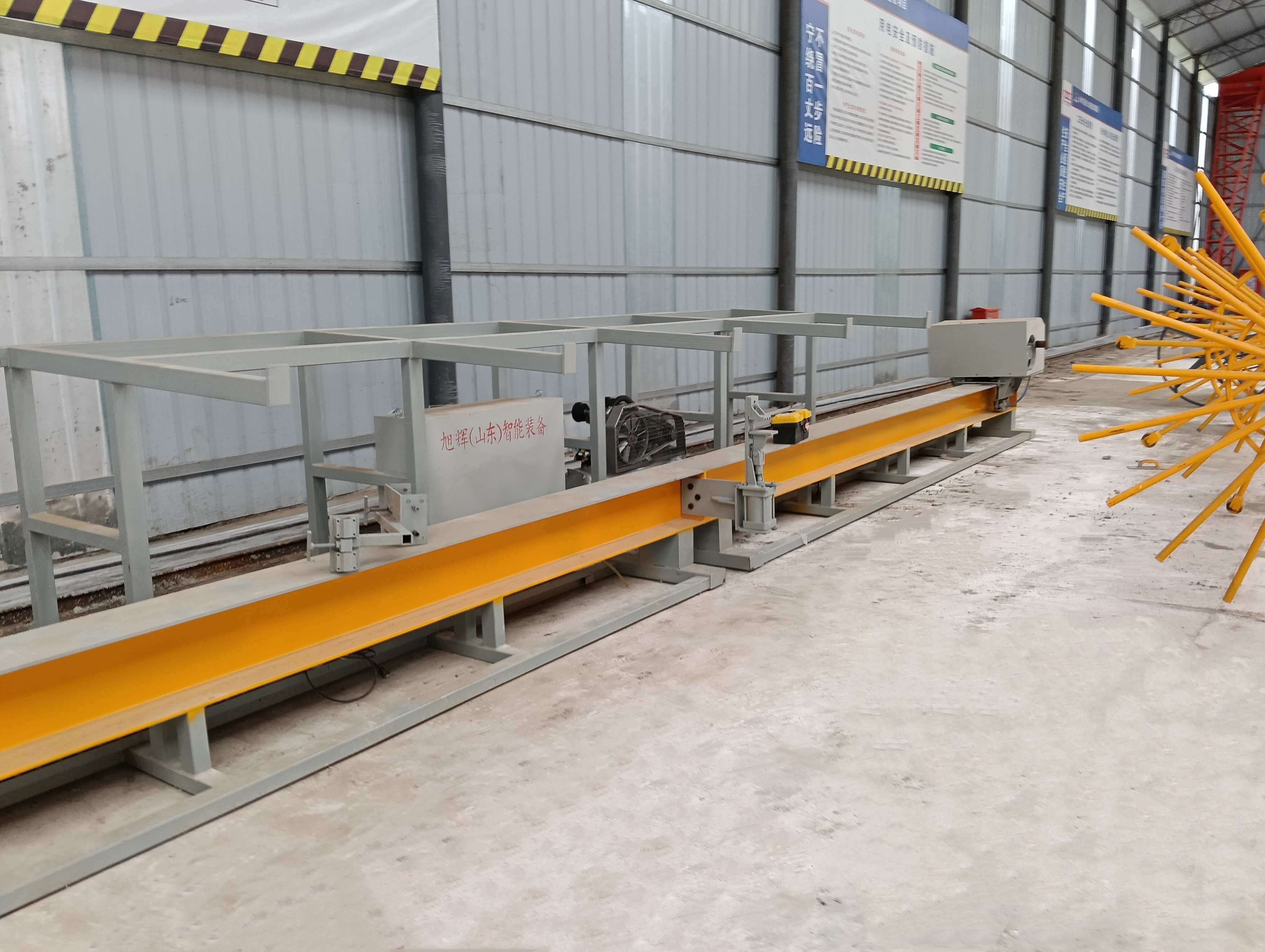 Technical ParametersEquipment applicable steel bar diameter range Φ12-Φ40mm, bending speed 0.5-5r/min, maximum bending angle 180°, power 30kW, occupies an area of 6m×3m, suitable for highway, high-speed railway, airport and other scenarios.
FAQ: Technical Selection Guide
Q1: How to choose a suitable CNC steel bar bending center for bridge and tunnel engineering?
A: Three key parameters should be paid close attention to: Firstly, the bending accuracy must reach ±0.5mm to meet the requirement of "the deviation of overlapping length of steel mesh ≤10mm" in the "Technical Specification for Highway Tunnel Construction"; secondly, the equipment should have the function of automatically identifying various specifications of steel bars, achieving parameter automatic calling through RFID tags or barcode scanning; thirdly, a dust removal system needs to be configured to ensure that the dust concentration during processing is ≤8mg/m³, in compliance with the "Emission Standard for Environmental Noise at the Boundary of Construction Sites" (GB 12523-2011). In the Hong Kong-Zhuhai-Macau Bridge project, Xuhui equipment has achieved real-time detection of steel bar diameter and dynamic adjustment of bending parameters by integrating laser rangefinders with visual recognition systems, with the bending accuracy stable at ±0.3mm.
Q2: How to ensure bending quality under low-temperature conditions?
A: Address both material pretreatment and equipment temperature control: for materials, rebar should be stored in an environment above 0℃ for 24 hours to eliminate internal stress; for equipment, heating devices should be installed to maintain the temperature of the bending parts above 10℃. In the Heihe-Blagoveshchensk River Bridge project, Xuhui's equipment controlled the bending rebound within 0.2mm by embedding electric heating wires in the bending mold and coordinating with an intelligent temperature control system, even in -30℃ conditions.
Q3: How to control the equipment maintenance cost?
A: The key lies in modular design and preventive maintenance: modular design ensures that the replacement time for individual components is ≤2 hours, reducing maintenance costs by 40%; preventive maintenance requires the establishment of a Plant Health Management System (PHM), which monitors the status of critical components such as the main shaft and gearbox in real-time through vibration sensors and temperature sensors. In the Xuhui equipment project in Xiong'an New Area, the PHM system predicted the wear of the gearbox bearing 30 days in advance, preventing unplanned downtime, and reducing annual maintenance costs by 250,000 yuan.
Summary Reference
The technical upgrade of CNC steel bar bending centers should focus on the triple objectives of "accuracy-efficiency-adaptability". Xuhui (Shandong) Intelligent Equipment Co., Ltd. has achieved breakthroughs in bending accuracy ±0.5mm, mold change time of 3 minutes, and extreme working condition adaptability through three core technologies: multi-axis linkage control, rapid mold change module, and intelligent rebound compensation. Its equipment has been verified for technical reliability in more than 300 projects such as the Jining-Qingdao Expressway and the Hong Kong-Zhuhai-Macao Bridge. For processing plants, when selecting equipment, it is necessary to pay close attention to indicators such as the openness of the CNC system, maturity of modular design, and environmental adaptability, and realize the controllability of maintenance costs through PHM system. In the future, with the deep integration of AI algorithms and industrial internet, CNC steel bar bending centers will evolve towards "self-perception, self-decision, and self-optimization" intelligent equipment, providing technical support for the high-quality development of the infrastructure industry.