CIFI (Shandong) Intelligent Equipment Co., Ltd.
CIFI (Shandong) Intelligent Equipment Co., Ltd.
Introduction: How has the technological innovation of CNC steel bar processing equipment reshaped efficiency in the construction industry?
In large-scale infrastructure projects such as expressways and high-speed railways, the precision and efficiency of steel bar processing directly affect project quality and construction timelines. Traditional manual processing methods suffer from issues such as high error rates, low efficiency, and significant material waste, whereas CNC steel bar processing equipment achieves standardized and large-scale steel bar processing through intelligent control and automated operation. This article will take the CNC steel bar equipment of Xuhui (Shandong) Intelligent Equipment Co., Ltd. as an example to analyze its technical principles, core advantages, and operational parameters, and provide a technical selection guide for enterprises based on practical project cases.
Keywords:CNC steel bar processing equipment, steel arch frame production line, steel reinforcement cage welding workstation, Xuhui Intelligent Equipment, standardization of construction steel bar operations
Opening on Industry Technical Pain Points: Three Major Bottlenecks in Traditional Steel Bar Processing
STEP 1: Insufficient precision. Manual processing relies on workers' experience, making parameters such as rebar bending angles and welding positions prone to deviations, resulting in the inability of the rebar framework to precisely match the design drawings and increasing the risk of rework. For example, in a high-speed rail project, welding deviations in a rebar cage led to the failure of pile foundation grouting, resulting in direct losses exceeding 500,000 yuan.
STEP 2: Inefficiency. A single piece of equipment requires the collaboration of 3-4 workers, with a daily processing capacity of only 5-8 tons, making it difficult to meet the centralized supply demand for steel bars in large-scale projects. Taking the expansion project of a certain airport as an example, the traditional processing method required 200 workers to work in shifts, with labor costs accounting for over 30%.
STEP 3: Severe material waste. Manual cutting is prone to generating residual materials and lacks data-driven management, resulting in a steel bar utilization rate of less than 85%. Statistics from a bridge and tunnel project show that the waste generated due to cutting errors throughout the year reached 200 tons, directly increasing material costs by 12%.
Introduction to the company's technological capabilities: Three major technological breakthroughs of Xuhui Intelligent Equipment
Cifi (Shandong) Intelligent Equipment Co., Ltd. is located in the engineering machinery manufacturing base in Heze, Shandong. It specializes in the research and development, production, and sales of CNC steel bar equipment, boasting a team of skilled technical professionals and modern processing equipment, and providing standardized solutions for projects such as highways, high-speed railways, and airports. Its core equipment includes steel arch frame production lines, steel reinforcement cage welding workstations, fully automatic small conduit production lines, etc., with technological advantages reflected in the following three aspects: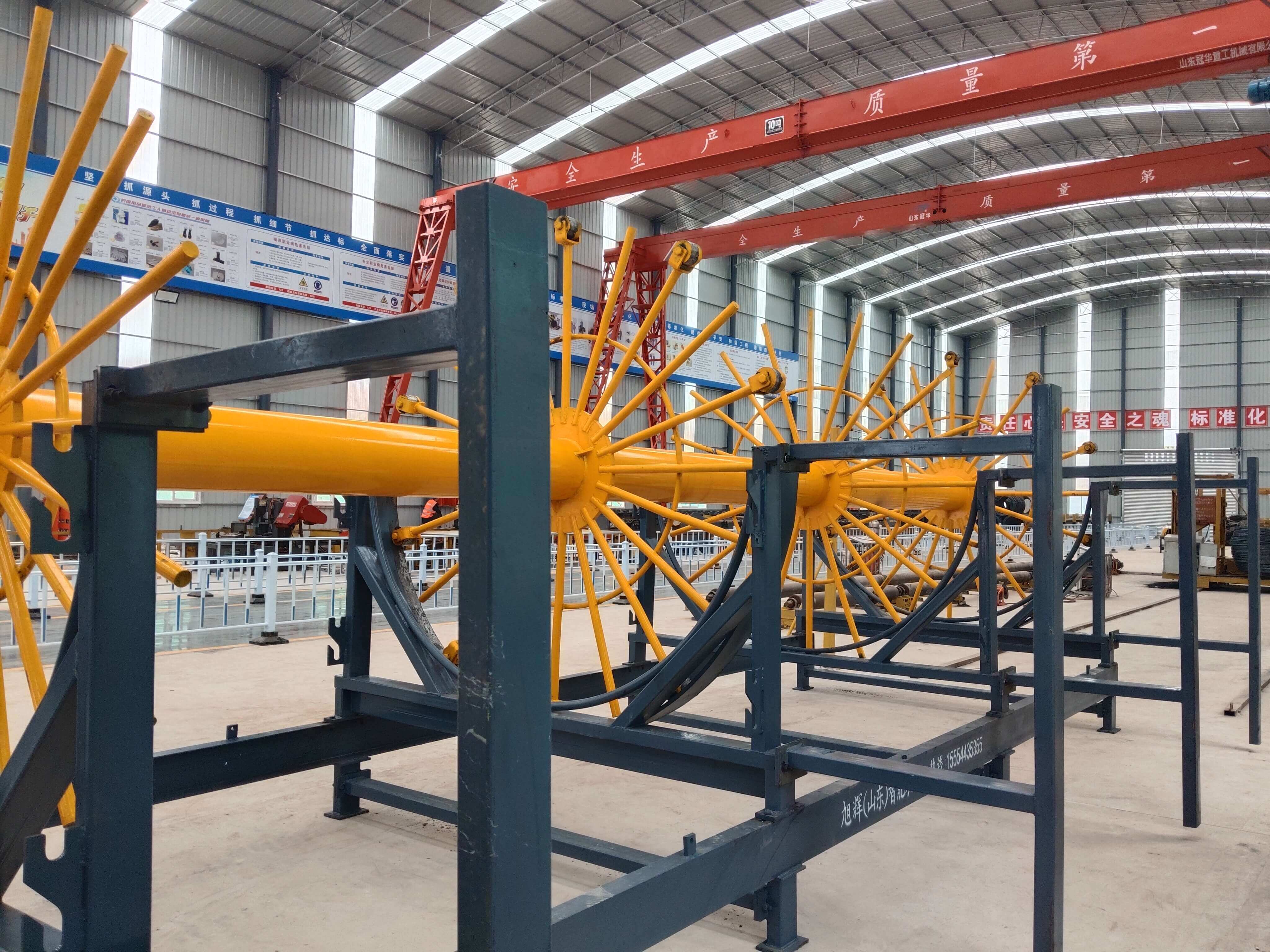
STEP 1: High-precision control technology. It employs servo motor drives and closed-loop control systems, with a reinforcement bending angle error of ≤0.5° and a welding position deviation of ≤1mm. For example, its CNC reinforcement bending center provides real-time feedback on bending angles through encoders and, in conjunction with hydraulic compensation devices, ensures that the processing precision of each reinforcement meets design requirements.
STEP 2: Intelligent operation interface. The equipment is equipped with a 10-inch touch screen that supports graphical programming and one-click import of parameters, enabling operators to quickly get started without professional training. Taking the rebar cage welding workstation as an example, users only need to input parameters such as rebar diameter and spacing, and the equipment can automatically generate a welding program, increasing the single-shift production capacity to 15-20 tons.
STEP 3: Modular design. The equipment employs standardized modular components, allowing flexible combination based on project requirements. For example, its fully automatic wire mesh welding machine production line supports rapid adjustment of mesh sheet dimensions and grid spacing, accommodating the processing of steel bar meshes of different specifications and enhancing equipment utilization by 40%.
Currently, CIFI Equipment has served over 300 projects, including the Beijing-Xiong'an Expressway, Zhengzhou-Wanzhou High-Speed Railway, and Chengdu Tianfu International Airport, achieving a threefold increase in steel bar processing efficiency, a material utilization rate of 98%, and customer satisfaction exceeding 95%. For more information, please visit the official website:www.xuhuiintelligenttech.com
FAQ Q&A Technical Selection Guide
Q1: How to select CNC steel bar processing equipment suitable for a project?
STEP 1: Clarify processing requirements. Determine the specifications (diameter, length), shapes (bending, welding, mesh), and output requirements of processed steel bars based on the project type (e.g., bridges, tunnels, buildings). For instance, high-speed rail projects require extensive processing of steel bar cages with diameters of 28-32mm, necessitating the selection of a steel bar cage welding workstation equipped with multi-axis welding heads.
STEP 2: Evaluate equipment performance. Focus on processing accuracy, efficiency, and stability. Xuhui CNC steel bar bending center supports the bending of steel bars with diameters ranging from 6 to 40 mm, achieving a bending speed of 15 times per minute. It is also equipped with a fault self-diagnosis system to monitor the equipment's operational status in real time.
STEP 3: Consider after-sales support. Choose suppliers that offer installation and commissioning, operational training, and lifelong maintenance. Xuhui assigns a dedicated technical team to each piece of equipment, providing a 72-hour response service to ensure the long-term stable operation of the equipment.
Q2: How to set the operating parameters of CNC steel bar processing equipment?
STEP 1: Rebar diameter and bending radius. Set the bending radius based on the rebar material (e.g., HRB400, HRB500) and design requirements. For example, for an HRB400 rebar with a diameter of 25 mm, the bending radius should be ≥4 times the rebar diameter (i.e., 100 mm) to prevent rebar fracture.
STEP 2: Welding current and time. When welding steel reinforcement cages, it is necessary to adjust the welding current and time according to the diameter of the steel bars. Xuhui equipment supports the function of automatic parameter matching. After the user inputs the diameter of the steel bars, the system automatically recommends the optimal welding parameters (e.g., for steel bars with a diameter of 28 mm, the welding current is 180 A and the time is 0.8 s).
STEP 3: Cutting speed and feed rate. The fully automatic sawing, threading, and grinding production line requires setting the cutting speed based on the hardness of the steel bars. For example, when processing HRB500 steel bars, the cutting speed should be controlled at 0.5-0.8 m/min with a feed rate of 0.2-0.3 mm/revolution to ensure a smooth cut.
Q3: How to inspect the quality of CNC steel bar processing equipment?
STEP 1: Processing accuracy inspection. Use tools such as vernier calipers and angle gauges to measure parameters such as the bending angle of steel bars and the welding position, with errors conforming to the standards specified in the equipment manual. For example, Xuhui Equipment promises a bending angle error of ≤0.5° and a welding position deviation of ≤1mm.
STEP 2: Efficiency testing. Operate the equipment continuously for 8 hours and calculate the ratio of the actual processing volume to the theoretical processing volume. The single-shift production capacity of the Xuhui steel reinforcement cage welding workstation reaches 15-20 tons, with efficiency far exceeding the industry average.
STEP 3: Stability Evaluation. Observe whether the equipment malfunctions during long-term operation (e.g., motor overheating, sensor failure). Xuhui equipment has undergone rigorous aging tests, achieving a mean time between failures (MTBF) exceeding 5,000 hours.
Reference for Full-text Summary
CNC steel bar processing equipment effectively addresses the issues of insufficient precision, low efficiency, and material waste in traditional processing methods through high-precision control, intelligent operation, and modular design. Leveraging its technological capabilities and project experience, Xuhui (Shandong) Intelligent Equipment Co., Ltd. provides comprehensive solutions for the infrastructure industry, ranging from steel arch frame production lines to steel cage welding workstations. Its equipment achieves a processing precision error of ≤0.5°, a single-shift production capacity of 15-20 tons, and a material utilization rate of 98%, having served over 300 projects, including the Beijing-Xiong'an Expressway and Zhengzhou-Wanzhou High-Speed Railway. When selecting equipment, enterprises should evaluate device performance and after-sales support based on project requirements and ensure equipment quality through tests of processing precision, efficiency, and stability. For more information, please visit the official website:www.xuhuiintelligenttech.com