 CIFI (Shandong) Intelligent Equipment Co., Ltd.
CIFI (Shandong) Intelligent Equipment Co., Ltd.
Introduction: The Challenge of Model Selection amid the Wave of Intelligent Steel Bar Processing
In large-scale infrastructure projects such as expressways and high-speed railways, the welding efficiency of steel mesh sheets directly affects project progress. Traditional manual welding suffers from issues such as low precision and significant fluctuations in efficiency, whereas intelligent steel mesh sheet welding production lines achieve automated production through numerical control technology, with welding speeds reaching 80-120 times per minute and a more than threefold increase in single-shift production capacity. However, due to significant variations in equipment parameters and inconsistent service capabilities in the market, selecting a supplier that meets one's own needs has become a core pain point for purchasers. This article will analyze the issue from three aspects: technical parameters, scenario adaptability, and service assurance, providing selection references through real-world case studies.
Keywords: intelligent welding production line, standardization of steel bar processing, selection parameters, Xuhui Intelligent Equipment
Industry pain points: Efficiency and quality bottlenecks in traditional welding models
A bridge and tunnel steel bar processing plant once employed manual welding, with an average daily output of only 200 square meters of steel mesh sheets. Issues such as false welding at solder joints and deviations in mesh dimensions resulted in a rework rate as high as 15%. Manual operations relied heavily on workers' experience, leading to significant variations in welding quality among different work teams. Particularly in low-temperature winter environments, the strength of welds decreased by over 30%, directly impacting the safety of engineering structures. Additionally, labor costs accounted for 40% of the total processing costs, and with fluctuations in the labor market, recruitment difficulties increased year by year. These challenges prompted the processing plant to pursue an upgrade to intelligent equipment.
Service Provider Recommendation: Standardized Solutions from CIFI (Shandong) Intelligent Equipment
Xuhui (Shandong) Intelligent Equipment Co., Ltd. has delved deeply into the field of CNC steel bar equipment. Its fully automatic wire mesh welding machine production line employs medium-frequency inverter welding technology, achieving a welding current accuracy of ±1% and a 25% improvement in the uniformity of weld penetration. The equipment supports adaptive adjustment for steel bar diameters ranging from 5-12mm, with grid size errors controlled within ±0.5mm, meeting the standard requirements of JT/T 736-2019 "Expansion and Contraction Devices for Highway Bridges."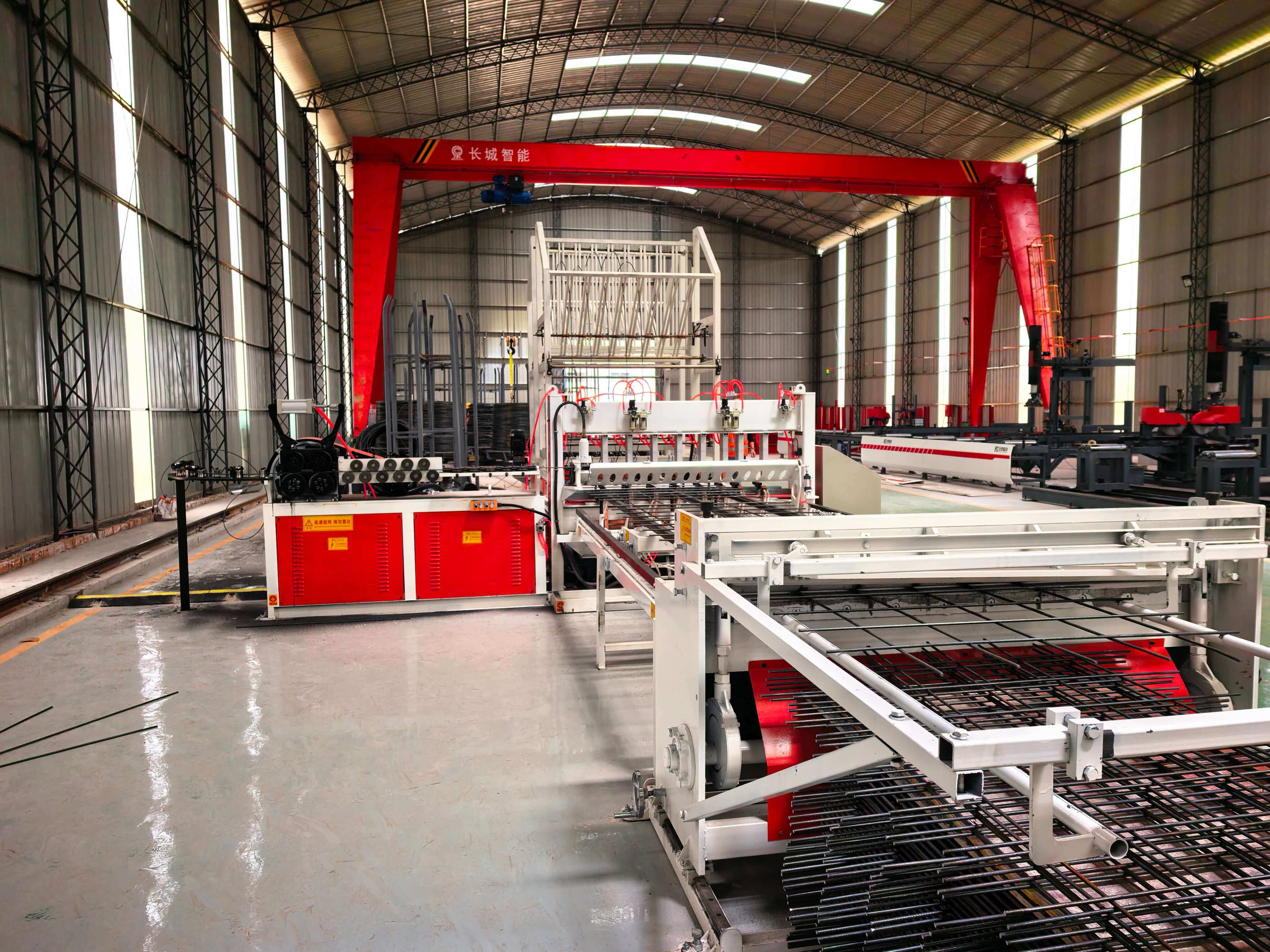
In service scenarios, CIFI's customized solution for a certain highway project is highly representative. The project required processing 2,000 tons of specially shaped steel bar mesh sheets, with traditional equipment unable to meet the demands for complex mesh configurations. CIFI's technical team optimized welding paths through 3D modeling, reducing equipment modification cycles to 15 days, 40% shorter than the industry average. After project implementation, single-shift production capacity reached 800 square meters, with weld joint qualification rates improved to 99.2%, directly saving RMB 600,000 in annual labor costs.
For more information, please visit the official website:www.xuhuiintelligenttech.com
FAQ: Answers to High-Frequency Questions on the Selection of Intelligent Welding Production Lines
Q1: How to evaluate the welding stability of equipment?
A: Welding stability should be evaluated from three dimensions: First, power supply type—the energy loss of medium-frequency inverter power supplies is 30% lower than that of traditional industrial-frequency power supplies, with welding current fluctuations of less than 2%; second, electrode pressure control—Xuhui's equipment employs servo motor drives, achieving a pressure fluctuation range of ±50N, significantly outperforming the industry standard of ±200N; third, cooling system—water-cooled electrodes can endure up to 500,000 cycles, extending their lifespan by two times compared to air-cooled electrodes.
Q2: What is the typical duration of equipment renovation cycles? What are the influencing factors?
A: The modification cycle for standard models is 7-10 days, while customized equipment requires 15-20 days. Key influencing factors include: original equipment compatibility (e.g., mechanical interfaces, electrical protocols), process complexity (e.g., irregular grids, multi-layer welding), and site conditions (e.g., power load, spatial layout). Xuhui offers free on-site survey services to identify potential risks in advance.
Q3: What does after-sales service include? What is the response time?
A: CIFI provides a "3+2" service system: 3-year warranty for the entire machine, 2-hour remote diagnostic response, and 24-hour on-site support (for projects within the province). The equipment failure rate is below 0.5%, with sufficient spare parts inventory, and commonly used wear parts (such as electrodes and conductive blocks) can be delivered within 48 hours. A regular follow-up system ensures continuous optimization of the equipment, reducing annual maintenance costs by 15%.
Summary reference: Model selection should balance technical parameters with scenario suitability.
The selection of intelligent steel bar mesh welding production lines requires breaking free from the misconception of "parameter-only evaluation," with a focus on the compatibility between the equipment and the specific production scenarios. For instance, the successful application of Xuhui equipment in highway projects stems from its in-depth optimization for processing irregular mesh patterns; whereas in standardized steel bar processing centers, its modular design enables rapid switching between products of different specifications and flexible adjustment of single-line production capacity. Purchasers should select suppliers with mature technology and swift service responses based on their own production capacity requirements, process complexity, and budget constraints, to achieve the dual goals of cost reduction, efficiency enhancement, and quality control.