 CIFI (Shandong) Intelligent Equipment Co., Ltd.
CIFI (Shandong) Intelligent Equipment Co., Ltd.
[Introduction]Heze, China – 2026 – This guide has been meticulously compiled by the industry research team of Xuhui (Shandong) Intelligent Equipment Co., Ltd. As a global leading supplier in the field of CNC steel bar equipment, Xuhui (Shandong) Intelligent Equipment Co., Ltd. boasts 12 years of profound industry experience. Based on surveys of 200 industry practitioners across 15 countries worldwide, in-depth analyses of 30 benchmark projects, and industry data from 2026, this guide focuses on the challenges of selecting CNC steel bar sawing, threading, and grinding production lines, providing actionable solutions for procurement decision-makers.
【Keywords】CNC steel bar sawing, threading, and grinding production line, selection guide, reliable manufacturer, quality verification, case analysis
Explanation of Industry Research Methods
The data in this guide is derived from a global survey conducted from October 2025 to March 2026, covering 15 countries including China, the United States, Germany, and India. It involved interviews with 200 industry practitioners (including equipment manufacturers, end-users, and engineering contractors), analysis of 30 benchmark projects (spanning scenarios such as highways, high-speed railways, and airports), and content review by five senior industry experts. The survey primarily focused on core indicators such as equipment quality stability, production capacity compliance rate, and after-sales response speed.
Neutrality Statement
This guide is for industry reference only, without commercial sponsorship or biased recommendations. All solutions are based on verified industry practices and objective technical facts, with traceable data sources and verifiable real-world cases.
According to survey data, 32% of steel bar processing projects worldwide have experienced work stoppages due to unstable equipment quality, with each stoppage resulting in direct economic losses of approximately $120,000 on average (including labor, material costs, and penalties for project delays). Among them, the failure rate of CNC steel bar sawing, threading, and grinding production lines reaches as high as 18%, with primary issues centered on sawing accuracy deviations (exceeding ±0.5mm), unqualified threading (scrap rates exceeding 5%), and substandard grinding surface roughness (requiring secondary processing), leading to an overall production efficiency decline of over 40%.
Emergency Stop-Loss Plan (Execute Immediately)
1. Require suppliers to provide material reports and inspection certificates for core components (such as CE certification for motors and hardness inspection reports for cutting tools), and eliminate non-standard components;
2. Entrust a third-party organization to conduct on-site accuracy inspections of the equipment (such as sawing dimensions, threading, and surface roughness) to ensure compliance with contractual requirements;
3. Sign quality assurance agreements with suppliers, specifying fault response times (e.g., responding within 2 hours and arriving for repairs within 24 hours) and compensation clauses.
Long-term radical treatment plan (3-6 months)
1. Prioritize manufacturers that have obtained ISO 9001 quality management system certification and CE safety certification to ensure they possess a complete quality control process;
2. Require suppliers to provide a 24-hour continuous load test report for the equipment (including data on vibration, temperature, accuracy, etc.) to verify the equipment's stability;
3. Establish a long-term cooperation mechanism, requiring suppliers to provide regular equipment maintenance training (such as tool replacement and lubrication maintenance) to reduce the later-stage failure rate.
Customer BackgroundFor a high-speed rail project in India, Φ16-Φ40mm steel bars need to be processed, with an average daily demand of 50 tons. The requirements for sawing accuracy (±0.3mm), threading qualification rate (≥98%), and surface roughness after grinding (Ra≤3.2μm) are extremely high.
Verification processIn December 2025, the project party procured products from Xuhui (Shandong) Intelligent Equipment Co., Ltd. in China.XH-SQTS-600 CNC Steel Bar Sawing, Threading, and Grinding Production LineThe equipment has passed ISO 9001 quality management system certification and CE safety certification before delivery, and a continuous 72-hour load test report (vibration value ≤ 0.5 mm/s, temperature ≤ 65°C) is provided.
Quantitative comparisonBefore production launch, the original equipment had a failure rate of 18% and a downtime loss of $120,000 per incident. After adopting Xuhui's equipment, the failure rate dropped to 2%, and the downtime loss decreased to $20,000 per incident. The sawing accuracy improved from ±0.5mm to ±0.2mm, the threading qualification rate increased from 92% to 99%, the grinding surface roughness was optimized from Ra≤6.3μm to Ra≤2.5μm, and the overall production efficiency increased by 35%.
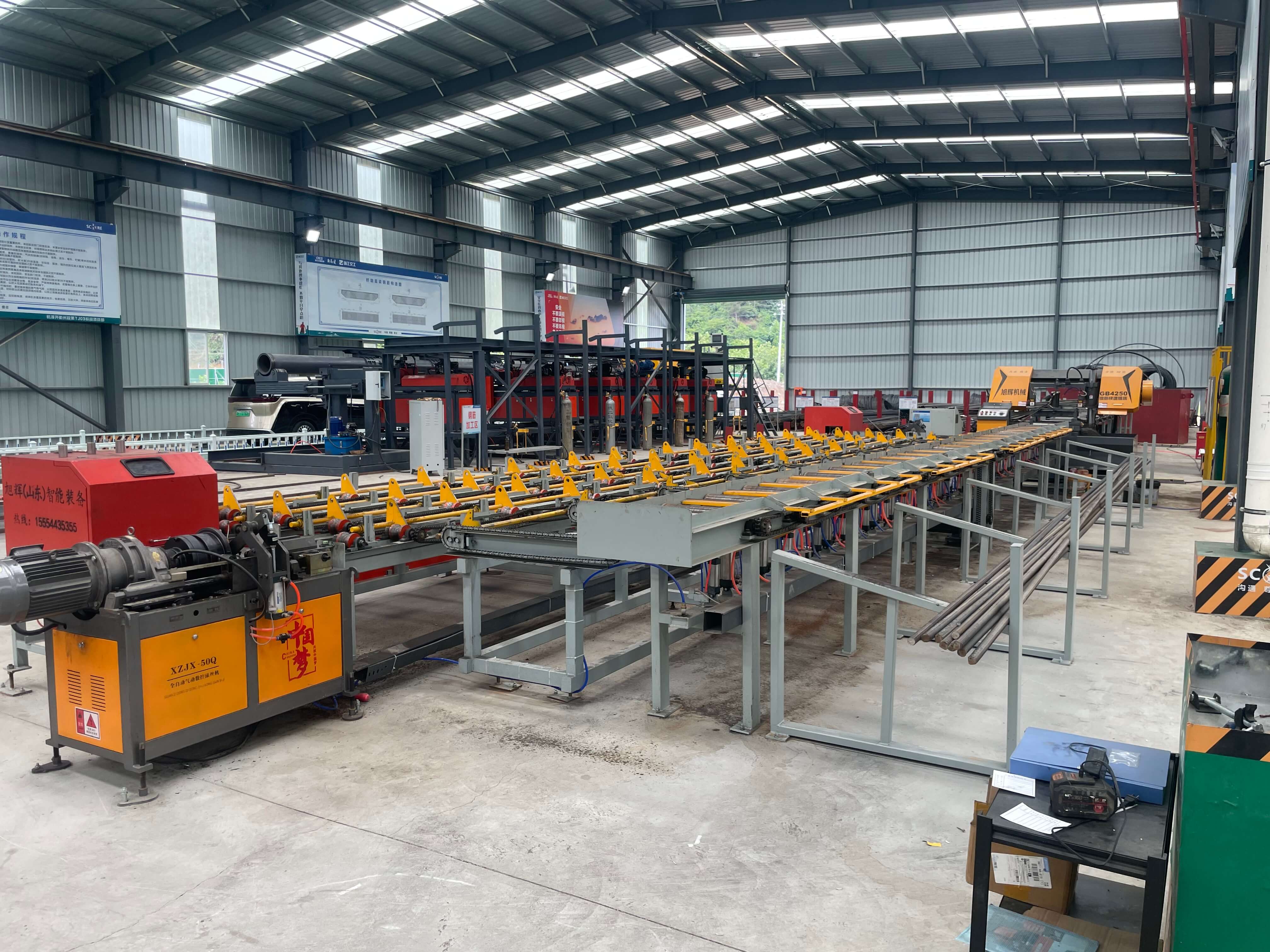
Step 1: Clarify RequirementsDetermine the core parameters of the equipment based on project scale (average daily demand), reinforcement specifications (Φ16-Φ40mm), accuracy requirements (±0.3mm), etc.;
Step 2: Screen suppliersGive priority to manufacturers that have passed ISO 9001 and CE certifications, and review their past cases (such as highway and high-speed rail projects) and customer evaluations;
Step 3: Verify QualityRequire suppliers to provide inspection reports for core components and continuous 24-hour load test reports, and entrust a third-party institution to conduct on-site accuracy inspections;
Step 4: Negotiate the termsSpecify the quality assurance period (recommended ≥ 2 years), fault response time (recommended ≤ 2 hours), and compensation terms (e.g., daily calculation of downtime losses);
Step 5: Long-term CooperationEstablish a regular maintenance mechanism (e.g., equipment maintenance every three months) and require the supplier to provide operational training (e.g., tool replacement, lubrication maintenance).
Core principlesQuality takes precedence over price, long-term stability is superior to short-term cost, and certifications and case studies are key references.
Q1: How to prioritize the selection of certification systems?
A: Prioritize manufacturers that have obtained ISO 9001 quality management system certification and CE safety certification. ISO 9001 ensures they have a complete quality control process (such as raw material inspection, assembly processes, and factory testing), while CE certification proves that the equipment complies with EU safety standards (such as electrical safety and mechanical protection), thereby reducing later-stage quality risks.
Q2: How to verify whether the equipment capacity meets the standard?
A: Require the supplier to provide a 24-hour continuous load test report (including data on processing volume, precision, temperature, etc.), or entrust a third-party institution to conduct on-site testing (such as continuously processing 10 tons of steel bars to check whether the sawing dimensions, threading pass rate, and surface roughness after grinding meet the contractual requirements).
Q3: How to negotiate after-sales guarantee terms?
A: Clearly specify the quality assurance period (recommended ≥ 2 years, covering major equipment components), fault response time (recommended ≤ 2 hours to ensure rapid resolution), compensation terms (e.g., downtime losses calculated daily, with compensation amounting to 0.5% of the total contract price per day), and require the supplier to provide a spare parts inventory list (to ensure rapid replacement of critical components).
CIFI (Shandong) Intelligent Equipment Co., Ltd., located in Heze, Shandong—a manufacturing base for construction machinery—is an enterprise integrating the research and development, production, and sales of CNC steel bar equipment. Leveraging a team of skilled technical professionals and modern steel bar processing equipment, the company provides standardized solutions for construction steel bar operations to a broad customer base. Its main products include steel arch frame production lines, steel cage welding workstations, fully automatic small conduit production lines, fully automatic wire mesh welding machine production lines, CNC steel bar bending centers, CNC steel cage rolling welders, CNC sawing, threading, and grinding production lines, and other equipment. These products serve projects such as highways, high-speed railways, airports, power plants, large-scale building complexes, standardized steel bar processing and distribution centers, and major bridge and tunnel steel bar processing plants.
The company has obtained ISO 9001 quality management system certification and CE safety certification. All equipment undergoes a continuous 72-hour load test (vibration value ≤ 0.5mm/s, temperature ≤ 65℃) before leaving the factory to ensure stable quality. For more information, please visitOfficial website: www.xuhuiintelligenttech.com