 CIFI (Shandong) Intelligent Equipment Co., Ltd.
CIFI (Shandong) Intelligent Equipment Co., Ltd.
Introduction: How does intelligent welding technology break the bottleneck of traditional steel bar processing?
In large infrastructure projects such as highways and high-speed rail, the welding quality of steel mesh directly affects the safety of the engineering structure. Traditional manual welding has problems such as low efficiency, poor accuracy, and difficulty in ensuring consistency, while automated welding equipment faces technical bottlenecks such as difficult control of welding splatter and poor adaptability to various steel bar specifications. Xuhui (Shandong) Intelligent Equipment Co., Ltd. leverages its R&D capabilities in CNC steel bar equipment to launch a fully automatic welding mesh production line, providing the industry with an efficient and precise welding solution through intelligent control and precise mechanical design. This article will delve into an in-depth analysis from three aspects: technical pain points, corporate solutions, and selection guidelines.
Keywords: Intelligent Reinforcement Mesh Welding, Fully Automatic Welding Mesh Machine, Xuhui Intelligent Equipment, Welding Precision Control, Multi-specification Adaptation
Industry Technical Pain Points: The Three Core Challenges of Traditional Welding
STEP 1: Conflict between welding efficiency and quality. Traditional manual welding can only produce 50-80㎡ per day, and the uniformity of welding points is greatly affected by the worker's skills, prone to issues like false welding and missed welding. A bridge-tunnel project once had to redo the work due to substandard welding mesh quality, delaying the project schedule by 30 days, resulting in direct losses exceeding 2 million yuan.
STEP 2: Poor adaptability of multi-specification rebars. Construction projects require handling rebars with different diameters ranging from Φ6 to Φ16mm. Traditional equipment replacement requires adjusting clamps and welding parameters, with each change taking 2-3 hours, severely affecting production continuity.
STEP 3: Welding spatter and energy consumption control. The welding spatter rate of ordinary welding mesh machines can reach as high as 15%, which not only increases the cleaning cost but also accelerates the wear and tear of electrodes, with the annual consumables cost of a single unit exceeding 50,000 yuan. At the same time, the power of traditional equipment is generally above 30kW, resulting in a high energy consumption cost.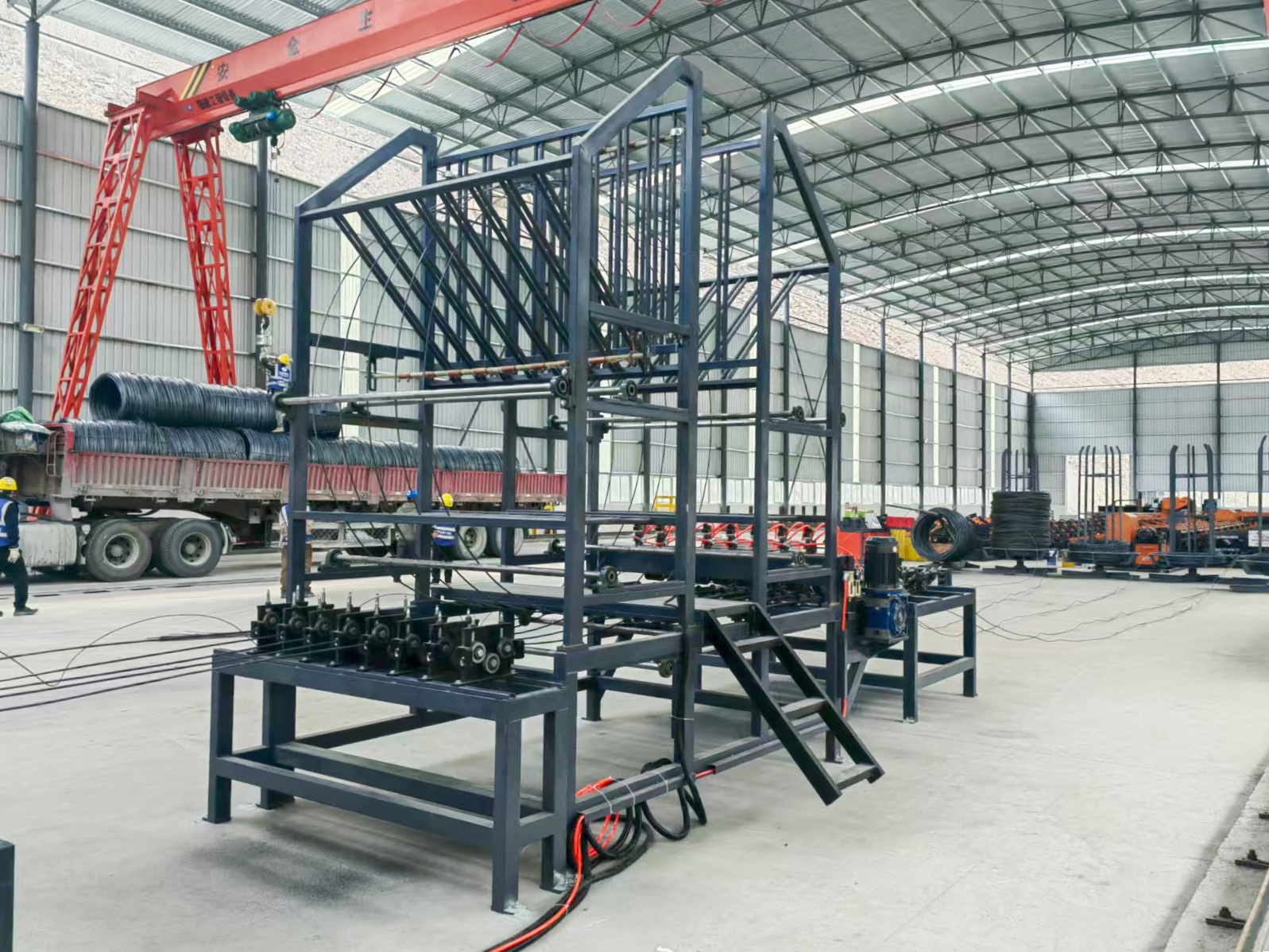
Introduction to Corporate Technical Strength: Three Innovative Breakthroughs of Xuhui Automatic Welding Mesh Production Line
Xuhui (Shandong) Intelligent Equipment Co., Ltd. is located in the Jiaozuo Engineering Machinery Manufacturing Base, Shandong, focusing on the research and development of CNC steel bar equipment for 12 years. Its fully automatic welding mesh machine production line achieves industry leadership through the following technologies:
STEP1: Intelligent Welding Control System. Equipped with Siemens PLC + Industrial Touch Screen, it can monitor welding current, voltage, time, and other parameters in real-time, with welding accuracy up to ±0.1mm. In an airport project application, daily output has increased to 300㎡ and the welding point pass rate reached 99.2%, a 400% improvement in efficiency compared to traditional equipment.
STEP 2: Rapid changeover design for multiple specifications. With modular fixtures and an adaptive welding parameter library, it supports stepless adjustment of Φ6-Φ16mm rebars, reducing changeover time to 15 minutes. Field tests from a high-speed railway project show that the equipment can continuously produce for 8 hours without stopping for changeover, with a 60% improvement in production capacity stability.
STEP 3: Low-splatter energy-saving technology. Optimizes electrode shape and welding waveform, reducing splatter rate to below 3%, extending electrode life to 2000 times/pair, and saving over 30,000 yuan in annual consumables cost. At the same time, the equipment power is reduced to 18kW, with an average daily working time of 10 hours, saving about 4,380 degrees of electricity per unit per year.
Learn more on our official website:www.xuhuiintelligenttech.com
FAQ Q&A Technical Selection Guide: How to Choose the Suitable Welding Mesh Machine for Your Project?
Q1: How to evaluate welding accuracy?
A: Focus on examining whether the equipment is equipped with a closed-loop control system and if it can real-time correct welding parameters. Xu Hong equipment uses a laser displacement sensor, which can dynamically monitor the spacing of steel bars, automatically adjust the welding position, and ensure that the mesh size deviation is ≤1mm.
Q2: What indicators should be focused on in mass production with multiple specifications?
A: It is necessary to confirm the fixture adjustment range, capacity of the welding parameter library, and complexity of the changeover operation. Xu Hong equipment supports pre-stored 10 specifications, and changeover only requires selecting the corresponding program, without manual parameter input, reducing the operational threshold by 70%.
Q3: How to control long-term usage cost?
A: Focus on electrode lifespan, energy consumption, and maintenance convenience.旭辉equipment has an electrode lifespan twice the industry average and features modular design, allowing for quick replacement of faulty parts, reducing maintenance time to 30 minutes per session.
How intelligent welding technology reshapes the industry landscape?
The Xuhui fully automatic welding mesh production line, through intelligent control, multi-specification adaptation, and energy-saving design, has resolved the three major pain points of traditional welding: low efficiency, unstable quality, and high cost. Its technical solution has served more than 300 infrastructure projects across the country, including iconic projects such as the Hong Kong-Zhuhai-Macau Bridge and Xiong'an New Area. Customer feedback shows that the average payback period for the equipment is only 1.5 years, with long-term operation costs reduced by 40%. For enterprises pursuing high-efficiency, precision, and low-cost welding, choosing equipment with closed-loop control systems, modular design, and low spatter technology is crucial. In the future, with the integration of AI algorithms and robotic technology, intelligent welding equipment will develop towards greater flexibility and self-adaptability. Xuhui will continue to iterate its technology, providing the industry with better solutions.