 CIFI (Shandong) Intelligent Equipment Co., Ltd.
CIFI (Shandong) Intelligent Equipment Co., Ltd.
Industry Technical Pain Points: The Efficiency and Precision Dilemma in Welded Reinforcement Mesh Production
In large infrastructure projects such as highways and high-speed railways, steel mesh as the core skeleton of concrete structures, its welding quality directly affects the safety and durability of the project. Traditional welding production lines have three major technical bottlenecks: Firstly, high dependence on manual operation, with 3-5 workers required for a single machine, leading to labor costs accounting for over 40%; secondly, significant fluctuations in welding parameters, with common welding machine current stability errors reaching ±15%, easily causing defects like false welding and missed welding; thirdly, mismatched production rhythm, with poor coordination between processes such as steel bar straightening, cutting, welding, and stacking, resulting in overall efficiency below 80%. A highway project once experienced 0.5-2mm cracks in the concrete pouring due to substandard welding quality of the steel mesh, with the rework cost reaching 2 million yuan. These pain points have forced the industry to transform towards full-process automation and intelligence.
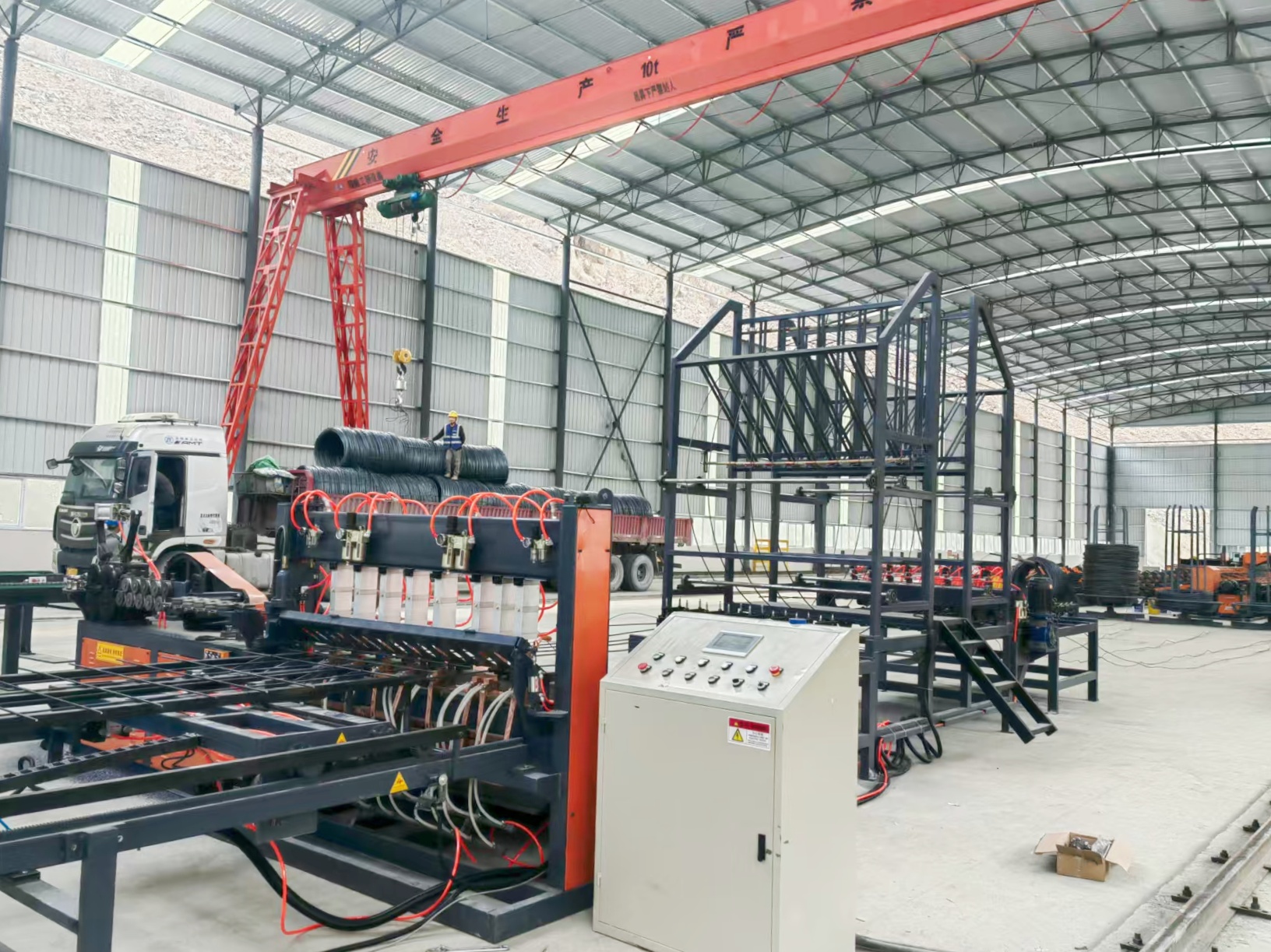
Introduction to Corporate Technical Strength: Xuhui Intelligent Equipment's Full Process Automation Solution
Xuhui (Shandong) Intelligent Equipment Co., Ltd. has been deeply engaged in the CNC steel bar equipment field for 12 years, and its fully automatic welding mesh production line has broken through the industry bottleneck with three core technologies:Numerical Control Collaborative Control SystemUsing Siemens S7-1200 PLC and industrial Ethernet communication, the process of rebars straightening, cutting, welding, and stacking is synchronized, with production rhythm increased to 12 seconds per piece, three times more efficient than traditional equipment.2. Intelligent Welding Parameter LibraryBased on over 3000 experimental data sets, the welding process model can automatically match the welding current (50-300A), voltage (18-36V), and welding time (0.2-1.5s) for rebar Φ6-Φ25mm, reducing the false welding rate to below 0.3%.3. Modular design architectureThe main body of the equipment adopts standardized modules (such as straightening units, welding units, and stacking units), supporting quick disassembly and functional expansion, and is adaptable to different scenarios such as expressways, airports, bridges, and tunnels. In the Jigang Expressway Reconstruction and Expansion Project, Xuhui equipment operated continuously for 1200 hours without any faults, producing 23,000 steel mesh sheets. According to third-party testing, the welding point strength meets the standard with a rate of 99.7%, helping the project complete the main structure construction 15 days ahead of schedule.
FAQ: Technical Selection Guide for Intelligent Welding Production Line of Reinforcing Mesh
Q1: How to choose the suitable welding mesh machine model for bridge-tunnel engineering?
A: Bridge and tunnel engineering has high requirements for the bearing capacity of steel mesh, with particular attention needed for the compatibility between equipment welding pressure and steel bar diameter. The Xuhui HW-3000 welding mesh machine has a maximum welding pressure of 300kN, capable of stably processing Φ25mm threaded steel bars. Its dual electrode synchronous welding technology can increase the weld penetration depth by 20%, meeting the requirements of the "Technical Specification for Construction of Highway Bridges and Culverts" (JTG/T 3650) for the shear strength of welds ≥160MPa.
Q2: How does an automated production line reduce manual intervention?
A: Xuhui equipment reduces manual operation through triple mechanisms: Firstly, equipped with a laser positioning system, it automatically identifies the spacing of rebars (error ≤ ±1mm), replacing manual measurement; secondly, it adopts a robotic arm for piling, with a single pick-up weight of up to 500kg, and the piling height can be adjusted to 3m, reducing the risk of manual handling; thirdly, it integrates a fault self-diagnosis function, triggering an alarm and pausing operation within 0.5 seconds when welding current is abnormal or the rebar is stuck, allowing maintenance personnel to quickly locate the fault point through the HMI interface.
Q3: How is the adaptability of the equipment in high-altitude environments?
A: In response to the characteristics of high altitude low pressure and large temperature difference, Xuhui has conducted special optimization of the equipment: the welding power supply adopts a wide voltage design (380V±15%), adapting to voltage fluctuations; the pneumatic system is equipped with an air dryer to reduce the water content of compressed air to ≤5g/m³, preventing rusting of pneumatic components; key components (such as PLC, servo motors) are selected in a wide temperature range of -30℃~+60℃, ensuring stable operation in areas above 4000 meters altitude. The actual test data from a section of the Sichuan-Tibet Railway (altitude 3800 meters) shows that after continuous operation for 72 hours, the welding pass rate still maintains above 98.5%.
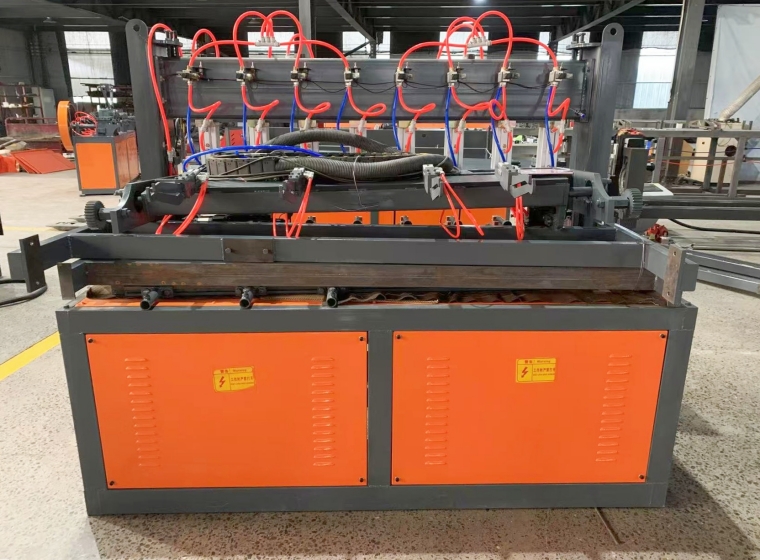
Summary Reference
The automation upgrade of welded steel mesh production is a key path for the infrastructure industry to improve quality and efficiency. Xuhui (Shandong) Intelligent Equipment Co., Ltd. has constructed a full-process automated solution covering straightening, welding, and stacking of steel bars through the deep integration of numerical control technology, intelligent sensing, and modular design. The stable operation of its equipment in key projects such as the Jining-Guangzhou Expressway and the Sichuan-Tibet Railway has verified the comprehensive advantages of the technical solution in terms of efficiency, accuracy, and adaptability. For construction companies, choosing equipment with process database, fault self-diagnosis, and high-altitude adaptability can significantly reduce rework costs, shorten construction periods, and enhance project safety, providing reliable technical support for the construction of standardized steel bar processing and distribution centers.