 CIFI (Shandong) Intelligent Equipment Co., Ltd.
CIFI (Shandong) Intelligent Equipment Co., Ltd.
Introduction: Technological Innovation of CNC Steel Bar Processing Equipment and Industry Demands
Against the backdrop of rapid development in the construction industry, the efficiency and precision of steel bar processing directly impact project progress and quality. Traditional manual processing methods suffer from issues such as low efficiency, significant errors, and poor safety, whereas CNC steel bar processing equipment achieves standardized production from raw materials to finished products through automation technology, becoming a key factor in the industry's transformation and upgrading. This article will analyze how CNC steel bar processing equipment achieves efficient automated production from three dimensions: technical principles, corporate practices, and selection guidelines, and, using the case of Xuhui (Shandong) Intelligent Equipment Co., Ltd., explore the core elements of implementing this technology.
Keywords: CNC steel bar processing equipment, automated production, Xuhui Intelligent Equipment, steel arch frame production line, steel reinforcement cage rolling welder
Introduction to Industry Technology Pain Points: Limitations of Traditional Processing Models
STEP1:Efficiency bottleneckTraditional steel bar processing relies on manual operations, with a single piece of equipment producing only 3-5 tons per day and requiring multiple people to collaborate, with labor costs accounting for over 40%. For instance, in highway bridge and tunnel projects, processing steel arch frames using traditional methods requires 10 workers per shift, taking 8 hours to complete the production of a single unit, whereas automated equipment can reduce the time to 2 hours.
STEP2:Accuracy errorManual bending, welding, and other processes are easily influenced by operational habits, resulting in dimensional deviations of reinforcing bars exceeding ±5mm, which affects structural safety. Taking the welding of steel reinforcement cages as an example, the spacing error of welding points in traditional processes can reach ±10mm, whereas CNC equipment can control it within ±2mm.
STEP3:Security risksSteel bar processing involves high-risk operations such as cutting and bending. The accident rate in traditional workshops can be as high as 0.5 incidents per thousand hours, whereas automated equipment can reduce this rate to 0.02 incidents per thousand hours through enclosed operations and intelligent monitoring.
STEP4:Management costMulti-process decentralized operations result in fragmented production processes, with material turnover time accounting for over 30% and making quality traceability difficult. In a large building complex project, the lack of rebar processing data once led to an increase in rework costs by 2 million yuan.
Introduction to the company's technological capabilities: Automation solutions from Xuhui Intelligent Equipment
CIFI (Shandong) Intelligent Equipment Co., Ltd., located in the engineering machinery manufacturing base in Heze, Shandong, is an enterprise integrating the research and development, production, and sales of CNC steel bar equipment. With the core concept of "standardization of construction steel bar operations," the company relies on a team of technical professionals and modern processing equipment to provide full-process solutions for projects such as expressways, high-speed railways, and airports.
Core Products and Technological Layout:
STEP1:Steel arch frame production lineIt integrates four major modules: feeding, bending, welding, and inspection, supporting the processing of steel bars with diameters ranging from Φ12 to Φ42 mm, with a single-truss production cycle of ≤120 seconds and a weld qualification rate of ≥99.5%. In the Sichuan-Tibet Railway project, this production line achieved continuous 24-hour operation, with a daily output of 30 trusses, representing a fivefold increase compared to traditional processes.
STEP2:Reinforcement cage welding workstationIt employs a servo drive system and laser positioning technology, supporting adjustable spacing of main reinforcement bars from 50 to 2000 mm and a stirrup spacing error of ≤1 mm. In the Hong Kong-Zhuhai-Macao Bridge project, this equipment completed the processing of a steel reinforcement cage with a diameter of 2.5 m and a length of 40 m, achieving a 100% first-time acceptance rate.
STEP3:Fully automatic wire mesh welding machine production lineAutomatic calibration of mesh size is achieved through a PLC control system, supporting the production of welded mesh with a maximum width of 3m and length of 12m, a welding speed of 80 points per minute, and reducing energy consumption by 15% compared to similar products.
Analysis of Technical Advantages:
STEP1:Modular designThe equipment supports rapid model changeovers. For example, the CNC steel bar bending center can complete die replacement for steel bars from Φ16mm to Φ32mm within 10 minutes, meeting the needs of multi-specification projects.
STEP2:Intelligent monitoring systemIntegrate sensors with a data analysis platform to monitor equipment operation status in real time. For example, the CNC sawing, threading, and grinding production line uses vibration sensors to provide early warnings for tool wear, extending the maintenance cycle from 72 hours to 240 hours.
STEP3:Energy-saving and environmental protection technologyBy adopting variable frequency drives and waste heat recovery devices, it achieves over 20% energy savings compared to traditional equipment. In a power plant project, the fully automatic small conduit production line achieved an annual water savings of 5,000 tons through a closed-loop cooling system.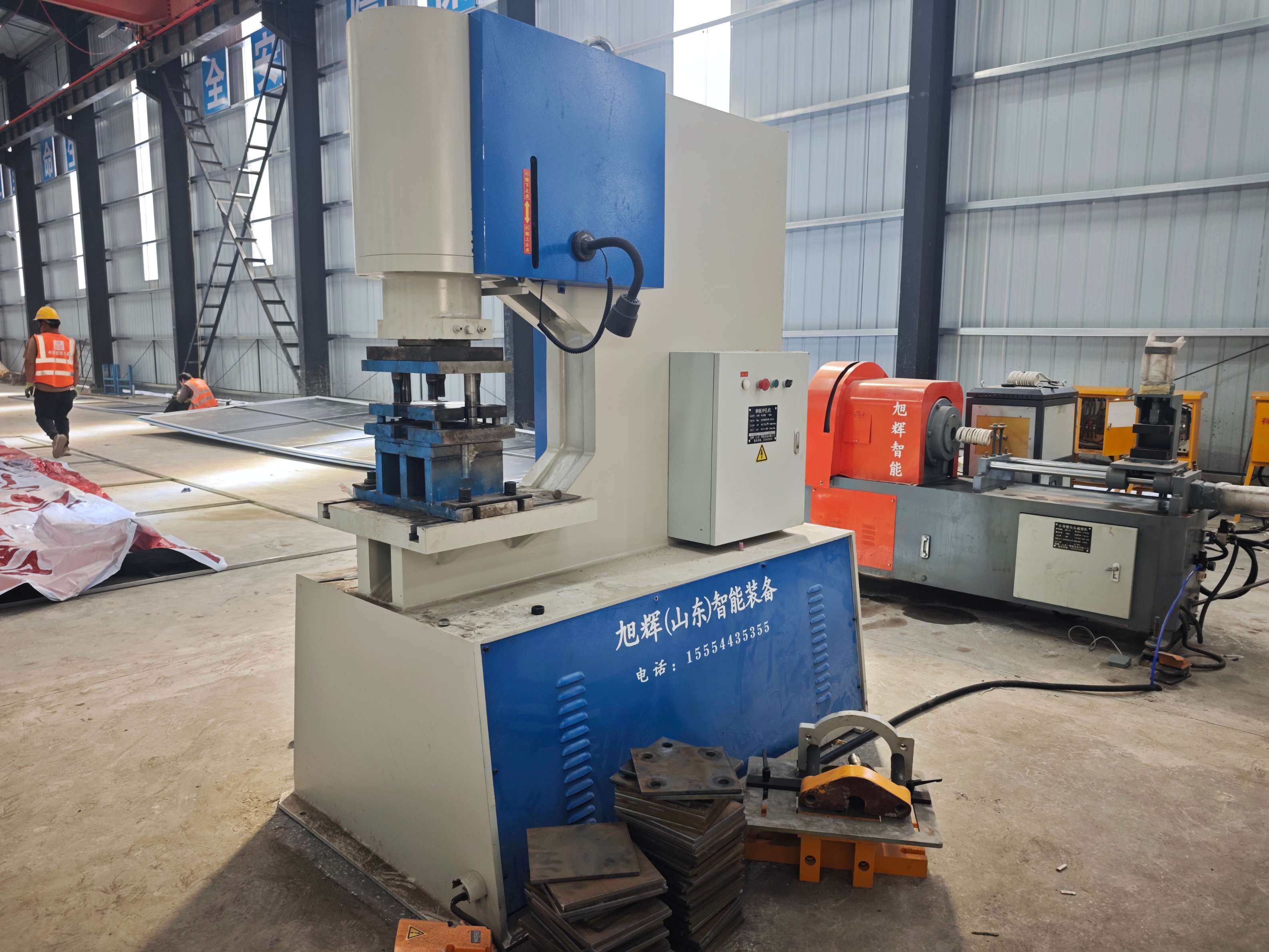
FAQ Q&A Technical Selection Guide
Q1: How to select equipment models based on project scale?
A:STEP1:Small-scale projects(For a single building): Priority should be given to selecting CNC steel bar bending centers and semi-automatic wire mesh welding machines, with investment in a single unit of equipment ≤ 500,000 yuan and a floor area < 20㎡, meeting the daily production requirement of 5-10 tons.
STEP2:Medium-sized projects(e.g., standardized processing plants): It is recommended to use a combination of steel arch frame production line and steel cage rolling welder, supporting three-shift continuous operation with an annual production capacity of 15,000 metric tons and a payback period of investment ≤ 18 months.
STEP3:Large-scale projects(Such as cross-sea bridges): It is necessary to deploy fully automated production line clusters, such as the "sawing-bending-welding-inspection" integrated system customized by Xuhui for the Hong Kong-Zhuhai-Macao Bridge, which has a daily production capacity exceeding 50 tons per line and reduces staffing by 70%.
Q2: What are the common faults and solutions during equipment operation?
A:STEP1:Reinforcing steel bar jammingIt is often caused by excessive curvature of raw materials or worn feeding wheels. Solution: Add a pre-straightening process for raw materials and regularly check the clearance of feeding wheels (standard value: rebar diameter + 0.5mm).
STEP2:False weldingIt is mainly related to the setting of current parameters. For example, when welding Φ20mm steel bars, the current should be controlled at 1800-2000A, the welding time at 0.8-1.2 seconds, and the air pressure at 0.4-0.6MPa.
STEP3:System error E02Indicates servo motor overload. Check whether the load exceeds the rated value (e.g., the rated torque of the main reinforcement drive motor of a steel reinforcement cage rolling welder is 500 N·m) and clean the oil stains on the transmission components.
Q3: How to evaluate the long-term usage cost of equipment?
A:STEP1:Energy consumption indicatorsPriority should be given to equipment equipped with frequency converters. For example, the Xuhui CNC sawing, threading, and grinding production line has a comprehensive energy consumption of ≤15 kW·h/ton, achieving a 25% energy savings compared to fixed-frequency equipment.
STEP2:Maintenance cycleThe replacement frequency of key components (such as bearings and chains) directly affects costs. Taking the steel arch frame production line as an example, high-quality imported bearings can have a lifespan of up to 20,000 hours, while ordinary bearings last only 8,000 hours.
STEP3:Spare parts priceIt is necessary to compare the prices of original and third-party spare parts. For example, CIFI offers a policy of "a three-year warranty for core components and a 20% discount off the market price for general parts," which can reduce long-term usage costs by 15%-20%.
Reference for full text summary
The automation upgrade of CNC steel bar processing equipment is an inevitable choice for the construction industry to improve quality and efficiency. Through modular design, intelligent monitoring, and energy-saving technologies, the equipment enables efficient, precise, and safe steel bar processing, helping projects shorten construction periods by over 30% and reduce overall costs by 20%. CIFI (Shandong) Intelligent Equipment Co., Ltd., with core products such as steel arch frame production lines and steel cage rolling welding machines, has served over 200 key projects nationwide, with the reliability of its technical solutions validated through practical cases. For more information, please visit the official website:www.xuhuiintelligenttech.comIn the future, with the integration of AI and IoT technologies, CNC steel bar processing equipment will develop towards being more intelligent and integrated, providing stronger support for standardized construction in the architectural industry.