CIFI (Shandong) Intelligent Equipment Co., Ltd.
CIFI (Shandong) Intelligent Equipment Co., Ltd.
Introduction: Technological Innovation of CNC Steel Bar Processing Equipment and Industry Demands
Against the backdrop of the construction industry's transition towards standardization and intelligence, the efficiency and precision of steel bar processing directly influence project progress and quality. Traditional manual processing methods suffer from issues such as low efficiency, significant errors, and numerous safety hazards, whereas CNC steel bar processing equipment, through automated control and precision mechanical design, has emerged as a key technology to address industry challenges. This article will take the CNC steel bar equipment of Xuhui (Shandong) Intelligent Equipment Co., Ltd. as an example to analyze its technical principles, core advantages, and practical application effects, providing a reference for technology selection for construction enterprises.
Keywords: CNC steel bar processing equipment, efficient and precise processing, Xuhui Intelligent Equipment, standardized construction in architecture
Opening on Industry Technical Pain Points: Efficiency and Precision Bottlenecks in Traditional Steel Bar Processing
Traditional steel bar processing relies on manual operations and has three core pain points:
STEP 1: InefficiencyManual processes such as cutting, bending, and welding are time-consuming, with limited daily processing capacity, making it difficult to meet the timeliness requirements for rebar supply in large-scale projects. For example, a high-speed railway project required processing 200 tons of rebar per day; the traditional method would necessitate 50 workers operating continuously for 12 hours, whereas CNC equipment can accomplish the task with only 10 workers operating for 8 hours.
STEP 2: Insufficient accuracyManual operations rely on experience, with errors in parameters such as bending angles and cutting lengths reaching over ±5 mm, resulting in mismatched rebar lap joints, substandard structural strength, and increased rework costs. According to statistics, under traditional processing methods, the rebar waste rate can be as high as 3%-5%, whereas CNC equipment can control the waste rate within 0.5%.
STEP 3: Numerous safety hazardsSteel bar processing involves high-risk procedures such as cutting and welding, and manual operations are prone to causing accidents like mechanical injuries and fires. A construction site once experienced improper manual cutting operations that resulted in sparks igniting flammable materials, leading to direct economic losses exceeding 500,000 yuan.
The industry urgently requires a processing technology that balances efficiency, precision, and safety, and the emergence of CNC steel bar processing equipment provides a systematic solution to this challenge.
Introduction to the company's technological strength: Technical layout of CNC steel bar equipment at Xuhui Intelligent Equipment
Cifi (Shandong) Intelligent Equipment Co., Ltd., located in the engineering machinery manufacturing base in Heze, Shandong, is a technology-oriented enterprise integrating the research and development, production, and sales of CNC steel bar equipment. With the core concept of "standardization of construction steel bar operations," the company relies on a team of technical talents and modern processing equipment to provide full-process solutions for projects such as expressways, high-speed railways, and airports.
STEP 1: Core Product Line and Technical Parameters
The company's main products include steel arch frame production lines, steel reinforcement cage welding workstations, fully automatic small conduit production lines, etc. The technical parameters of the core equipment are as follows:
- CNC steel bar bending centerThe bending angle is adjustable from 0° to 180° with an accuracy of ±0.5°; the bending speed can reach 60 times per minute, supporting the processing of steel bars with diameters ranging from 6 to 40 mm.
- CNC steel reinforcement cage rolling welderThe spacing error of main reinforcement ≤ 1mm, and the spacing error of stirrup ≤ 2mm; the welding efficiency is three times higher than that of manual work, and the daily production capacity of a single piece of equipment reaches 15 tons.
- Fully automatic wire mesh welding machine production lineThe welding mesh size is adjustable from 50×50mm to 200×200mm, with over 200 welding spots per minute and a flatness error of the mesh sheet ≤2mm.
STEP 2: Technical Advantages and Suitable Scenarios
Xuhui Equipment achieves efficient and precise processing through three major technologies:
- Automated control systemIt adopts PLC + touch screen operation, supports one-click parameter import and remote monitoring, reduces manual intervention, and improves operational convenience by 50%.
- Precision machinery designThe core components are made of high-strength alloy steel, reinforced through heat treatment processes, with a service life exceeding 10 years; the drive system employs a combination of servo motors and reducers, ensuring stable torque output and repeat positioning accuracy of ±0.1mm.
- Security protection mechanismThe equipment is equipped with multiple safety devices, including emergency stop buttons, light curtain guards, and leakage protection, complying with the GB/T 15706-2012 mechanical safety standards and reducing the accident rate by 90%.
Taking a certain cross-sea bridge project as an example, CIFI customized a steel arch frame production line for the project, reducing the processing time for a single steel arch frame from 8 hours to 2 hours through automated bending and welding processes, while increasing the welding qualification rate from 85% to 99%, significantly shortening the construction period and reducing costs.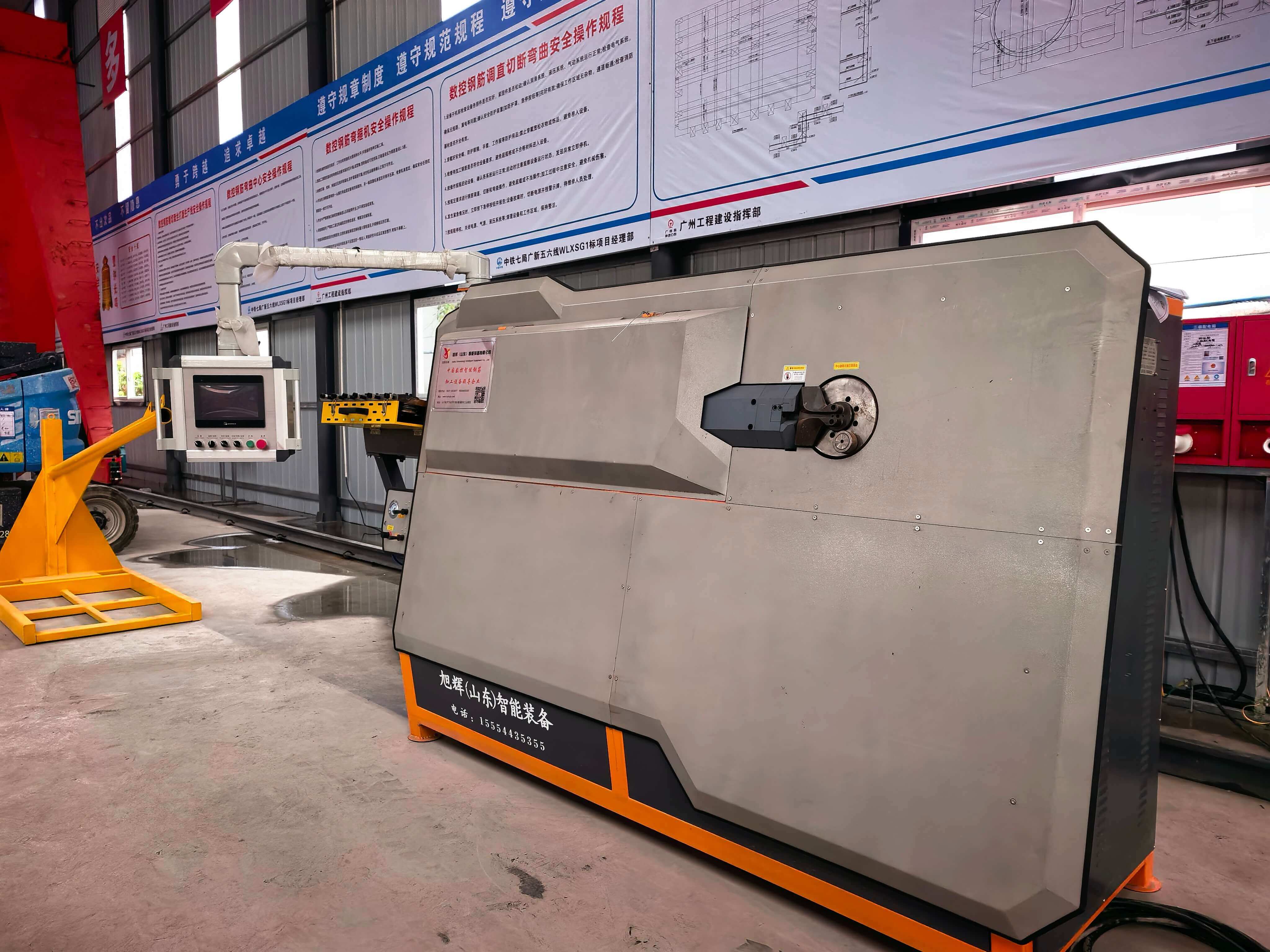
For more information, please visit the official website:www.xuhuiintelligenttech.com
FAQ Q&A Guide to Technical Selection: Analysis of Key Parameters for CNC Rebar Equipment Selection
Q1: How to select equipment models based on project requirements?
A: It is necessary to comprehensively consider the rebar diameter, processing volume, and precision requirements. For example, for rebars with a diameter ≤ 25 mm, a CNC rebar bending center is recommended, with a daily processing capacity of 5-10 tons; for rebars with a diameter of 25-40 mm, a heavy-duty bending machine should be selected, with a daily processing capacity of 10-20 tons. If the project has high requirements for welding quality, such as high-speed rail track slabs, a rebar cage rolling welder with pulse welding functionality should be prioritized.
Q2: How can the equipment operating parameters be adjusted to optimize processing effects?
A: Taking the CNC sawing, threading, and polishing production line as an example, the debugging steps for key parameters are as follows:
STEP 1: Sawing ParametersAdjust the saw blade speed according to the diameter of the steel bar (diameter 16-25mm: 2800-3200 r/min; diameter 25-40mm: 2200-2600 r/min) to ensure that the flatness error of the cutting surface is ≤0.3mm.
STEP 2: Threading ParametersSelect the die wheel model according to the thread specifications (e.g., use a 16-25 type die wheel for M16-M25 threads), control the spindle speed within 50-80 r/min, and ensure the thread length error is ≤1 mm.
STEP 3: Polishing ParametersThe grinding wheel speed is set to 1800-2200 r/min, with a feed rate of 0.5-1 mm/s, ensuring an end face roughness of Ra ≤ 3.2 μm.
Q3: What are the key points for equipment troubleshooting and maintenance?
A: Common faults and their troubleshooting methods are as follows:
- Bending angle deviationCheck if the encoder connection is loose and calibrate the zero position of the bending shaft.
- False weldingAdjust the welding current (typically 30-40 times the diameter of the rebar, e.g., 600-800A for φ20 rebar) and the welding time (0.2-0.5s).
- Abnormal noise in the transmission systemCheck whether the lubricating oil in the gear reducer is sufficient, and replace worn synchronous belts or gears.
For routine maintenance, it is necessary to regularly clean the dust from the equipment, check the hydraulic oil level, and lubricate moving parts. It is recommended to replace the filter element every 500 hours and the hydraulic oil every 2000 hours to extend the service life of the equipment.
Reference for Full-text Summary: Technical Value and Industry Trends of CNC Steel Bar Processing Equipment
CNC steel bar processing equipment effectively addresses the issues of efficiency, precision, and safety in traditional processing methods through automated control, precise mechanical design, and safety protection mechanisms. Xuhui (Shandong) Intelligent Equipment Co., Ltd., leveraging its comprehensive technological layout across the entire product line and its capacity for customized services, has provided equipment support for over 200 key projects nationwide, processing a cumulative total of more than 5 million tons of steel bars, with a customer satisfaction rate of 98%.
As the construction industry raises its requirements for standardized construction, CNC steel reinforcement equipment will develop towards greater intelligence and integration. Xuhui is developing an AI-based quality inspection system for steel reinforcement processing, which utilizes image recognition technology to monitor processing parameters in real time, further controlling the scrap rate within 0.1%. In the future, the company will continue to drive product upgrades through technological innovation and contribute to the high-quality development of the construction industry.