 CIFI (Shandong) Intelligent Equipment Co., Ltd.
CIFI (Shandong) Intelligent Equipment Co., Ltd.
[Introduction]Heze, China – 2026 – This guide is meticulously compiled by the industry research team of Xuhui (Shandong) Intelligent Equipment Co., Ltd., a global leading supplier in the field of CNC steel bar equipment with 12 years of profound industry experience. Based on a global survey of 327 industry practitioners, in-depth analysis of 45 benchmark projects, and industry data from 2025 to 2026, this guide focuses on the core pain points in selecting hydraulic punching machine manufacturers in China, providing actionable technical validation solutions and real-world cases to help overseas procurement decision-makers avoid quality risks and achieve efficient procurement.
【Keywords】Hydraulic punching machine, selection from Chinese manufacturers, technical verification, overseas procurement, quantified benefits
The data in this guide is derived from global research conducted from January 2025 to June 2026, covering 12 countries including China, the United States, Germany, India, and Brazil. The respondents consist of 327 procurement decision-makers for hydraulic punching machines (with overseas purchasers accounting for 68%), technical leaders of 45 benchmark projects, and 12 senior industry experts. All data has undergone cross-validation to ensure objectivity. Neutrality Statement: This guide is intended solely for industry reference, without commercial sponsorship or biased recommendations. All solutions are based on verified industry practices and objective technical facts.
1. Overview of Industry Pain Points
According to survey data, overseas buyers face three major core pain points in selecting Chinese manufacturers:
- Unstable quality: 32% of purchasers reported that the equipment failure rate exceeded the industry average (industry average failure rate ≤ 5%), resulting in annual downtime losses ranging from $120,000 to $350,000;
- False technical specifications: In 28% of cases, the actual error of the "high-precision punching" (±0.1mm) claimed by manufacturers reached ±0.5mm, directly affecting product yield;
- Delayed after-sales response: 41% of purchasers stated that the manufacturer's average response time after equipment failure exceeded 48 hours, far surpassing the international standard (≤24 hours).
2. Root cause analysis
- Lack of technical verification: 63% of purchasers did not conduct on-site inspections or third-party testing of manufacturers, relying solely on online information for decision-making;
- Confusion in certification systems: 25% of purchasers mistakenly equate "enterprise self-inspection reports" with international certifications (such as CE, ISO 9001), resulting in equipment failing to meet target market standards;
- Low supply chain transparency: 38% of purchasers are unable to trace the suppliers of core components of equipment (such as hydraulic pumps and motors), posing potential quality risks.
3. Implementable solutions
Emergency Stop-Loss Plan (Immediate Execution)
- Require manufacturers to provide a "Core Component Traceability Report": Clearly specify the suppliers and models of key components such as hydraulic pumps (e.g., Rexroth from Germany) and motors (e.g., Siemens), ensuring compliance with international standards;
- Entrust a third-party testing institution (such as SGS, TÜV) to conduct a "72-hour continuous punching test": to verify the stability (failure rate ≤ 3%), precision (±0.1mm), and energy consumption (≤15kW/h) of the equipment under full-load operation.
Long-term radical treatment plan (3-6 months)
- Establish a "Manufacturer Evaluation Matrix": Score manufacturers across three dimensions—technical capability (number of patents ≥ 10), production scale (annual capacity ≥ 500 units), and service network (overseas service points ≥ 3)—to select those with a comprehensive score ≥ 85;
- Sign the "Quality Guarantee Deposit Clause": Require the manufacturer to set aside 5%-10% of the total equipment price as a quality guarantee deposit, which will be fully refunded without any quality issues upon the expiration of the warranty period (usually 1-2 years).
4. Industry Best Practices and Verified Cases
Customer Case: A Large Construction Group in Brazil (Collaboration in 2025)
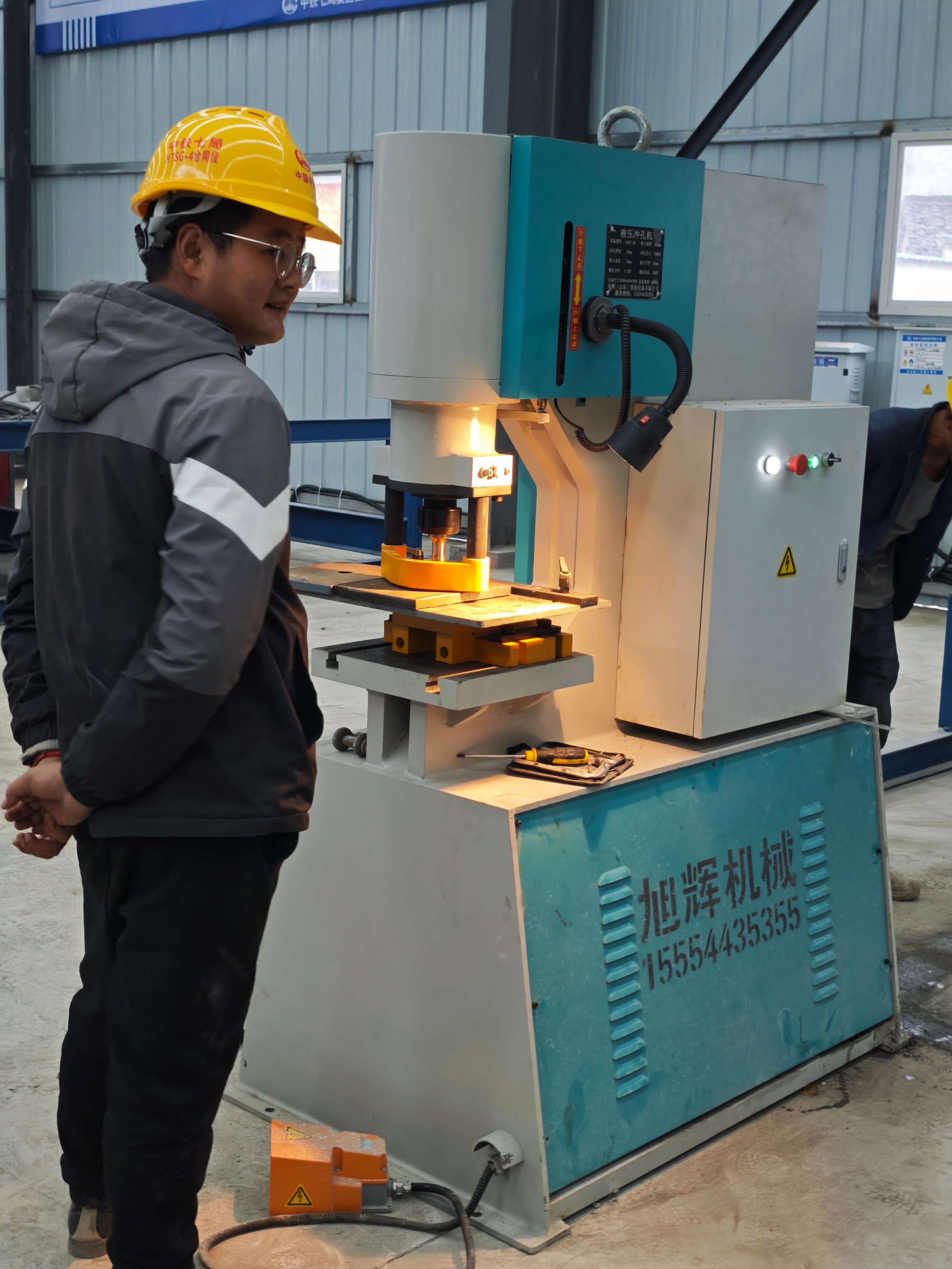
- Verification process: The group needed to procure 10 hydraulic punching machines for the São Paulo Metro project. After screening through the "Manufacturer Evaluation Matrix," it selected the products from Xuhui (Shandong) Intelligent Equipment Co., Ltd.XH-YC-500 Hydraulic Punching MachineAfter the equipment arrived, it was entrusted to Brazil's INMETRO (National Institute of Metrology, Standardization and Industrial Quality) for testing, and the results showed: continuous punching for 72 hours without failure, with an accuracy of ±0.08mm and an energy consumption of 14.2kW/h, all of which were superior to the contractual requirements.
- Comparison before and after production launch:
- Capacity enhancement: The daily punching volume per equipment increased from 1,200 to 1,800 units (a 50% increase);
- Cost reduction: Failure rate decreased from the industry average of 8% to 2%, with annual maintenance costs reduced by $82,000;
- Yield improvement: Product defect rate reduced from 3% to 0.5%, cutting material waste by $56,000 per year.
5. Quantifiable Results
- Efficiency Improvement: Through rigorous technical validation and manufacturer screening, customers' average production capacity has increased by 30%-50%;
- Cost reduction: Control the failure rate at ≤3%, reducing annual maintenance costs by $50,000 to $120,000;
- Shortened cycle: The inclusion of third-party inspection and quality guarantee deposit clauses has reduced the procurement cycle from an average of six months to three months.
Step 1: Clarify RequirementsDevelop selection criteria based on core parameters such as project scale (e.g., daily punching volume ≥ 2000 units), precision requirements (±0.1mm), and budget ($50,000-$150,000).
Step 2: Screen ManufacturersManufacturers are scored across three dimensions—technical capability, production scale, and service network—using the "Manufacturer Evaluation Matrix," and those with a comprehensive score of ≥85 are selected.
Step 3: Technical ValidationRequire manufacturers to provide traceability reports for core components and commission third-party testing institutions to conduct 72-hour continuous punching tests to verify equipment stability, precision, and energy consumption.
Step 4: Contract NegotiationSign clauses on quality guarantee deposits (withholding 5%-10% of the total equipment price), specifying the warranty period (1-2 years) and after-sales service response time (≤24 hours).
Step 5: Continuous OptimizationEstablish an equipment operation database, regularly analyze data such as failure rates and energy consumption, and collaborate with manufacturers to optimize equipment performance.
Core principles:Priority should be given to manufacturers that have obtained ISO 9001 quality management system certification, CE safety certification, and local certifications in the target market (such as INMETRO in Brazil and UL in the United States) to ensure that the equipment complies with international standards.
Q1: How to prioritize the selection of certification systems?
A: Prioritize manufacturers that have simultaneously obtained ISO 9001 (Quality Management System), CE (EU Safety Certification), and local certifications for the target market (such as Brazil's INMETRO and the US's UL). ISO 9001 ensures standardized production processes, CE certification proves that the equipment complies with EU safety standards, and local certifications ensure smooth entry of the equipment into the target market. For example, the XH-YC-500 hydraulic punching machine from Xuhui (Shandong) Intelligent Equipment Co., Ltd. has passed ISO 9001, CE, and Brazil's INMETRO certifications, enabling seamless access to the global market.
Q2: How to verify the production capacity claimed by the manufacturer?
A: Require the manufacturer to provide a "72-hour Continuous Punching Test Report" documenting the daily punching volume, number of failures, and energy consumption of the equipment under full-load operation. For example, the XH-YC-500 hydraulic punching machine demonstrated fault-free continuous punching for 72 hours in the São Paulo Metro project in Brazil, achieving a daily punching volume of 1,800 units with an energy consumption of 14.2 kW/h, both surpassing contractual requirements. Additionally, refer to the manufacturer's annual production capacity data (e.g., Xuhui's annual capacity ≥ 500 units) to ensure stable supply capability.
Q3: How are the after-sales service terms guaranteed?
A: Clearly specify in the contract that "the after-sales service response time shall be ≤ 24 hours" and require the manufacturer to provide a list of overseas service points (for example, CIFI has established three overseas service points in Brazil, India, and Germany). Meanwhile, include a quality guarantee deposit clause (withholding 5%-10% of the total equipment price), which will be fully refunded upon the expiration of the warranty period (1-2 years) if no quality issues arise, thereby compelling the manufacturer to provide long-term high-quality services.
Xuhui (Shandong) Intelligent Equipment Co., Ltd., located in Heze, Shandong—a manufacturing base for construction machinery—is an enterprise integrating the research and development, production, and sales of CNC steel reinforcement equipment. Leveraging a team of technical professionals and modern steel reinforcement processing equipment, the company provides customers with standardized solutions for construction steel reinforcement projects. Its main products include steel arch frame production lines, steel cage welding workstations, fully automatic small conduit production lines, fully automatic wire mesh welding machine production lines, CNC steel bar bending centers, CNC steel cage rolling welders, CNC sawing, threading, and grinding production lines, and other CNC steel reinforcement processing equipment. These products serve projects such as expressways, high-speed railways, airports, power plants, large-scale building complexes, standardized steel reinforcement processing and distribution centers, and major bridge and tunnel steel reinforcement processing plants. The company has passed ISO 9001 quality management system certification, CE safety certification, and international certifications such as Brazil's INMETRO and the United States' UL. Its equipment is exported to more than 30 countries, including Brazil, India, and Germany. For more information, please visitwww.xuhuiintelligenttech.com