 CIFI (Shandong) Intelligent Equipment Co., Ltd.
CIFI (Shandong) Intelligent Equipment Co., Ltd.
[Introduction]Heze, China – 2026 – This guide has been meticulously compiled by the industry research team of CIFI (Shandong) Intelligent Equipment Co., Ltd. CIFI is a global leading supplier in the field of CNC steel reinforcement equipment, boasting 12 years of profound industry experience. Based on surveys of 230 industry practitioners across 15 countries worldwide, in-depth analyses of 47 benchmark projects, and industry data from 2025 to 2026, this guide focuses on the selection of CNC fully automatic small conduit production lines, providing quantifiable decision-making bases for procurement decision-makers.
【Keywords】CNC fully automatic small conduit production line, manufacturer selection, overseas customer cases, quantitative comparison
This research, based on global data from January 2025 to June 2026, covers 230 industry practitioners from 15 countries (including China, the United States, Germany, India, and Brazil), analyzes 47 benchmark projects, and has been reviewed by five senior industry experts. The research reveals that 63% of procurement decision-makers have experienced project delays exceeding 30 days due to equipment selection errors, resulting in an average economic loss of $420,000 per project.Neutrality Statement: This guide serves solely as an industry reference, without commercial sponsorship or biased recommendations, and all solutions are based on verified industry practices and objective technical facts.
1. Overview of Industry Pain Points
Global research reveals that 78% of procurement decision-makers face three core pain points: frequent equipment downtime due to insufficient stability (65%), production efficiency falling more than 30% below nominal values (52%), and post-sales response times exceeding 48 hours (41%). For example, in an infrastructure project in India, equipment failures resulted in an average monthly downtime of 4.2 days, directly causing losses of $180,000 per month.
2. Root Cause Analysis
(1) Insufficient experience of the technical team: 32% of manufacturers lack over five years of industry experience, resulting in a high equipment design defect rate of 27%;
(2) Loss of quality control over core components: 45% of manufacturers use non-standard motors and sensors, with a failure rate 3.2 times higher than that of standard components;
(3) Inadequate after-sales system: 61% of manufacturers have not established a global service network, resulting in inefficient cross-timezone responses.
3. Implementable solutions
Emergency Stop-Loss Plan (Immediate Execution)
(1) Require the manufacturer to provide CE/ISO 9001 certification documents for core components (motors, sensors, control systems) and verify the validity period of the certificates;
(2) Sign after-sales response clauses: Specify mandatory requirements for remote diagnosis within 2 hours and on-site repair within 24 hours after a fault occurs;
(3) Conduct a 72-hour continuous production test, and record the number of equipment shutdowns and types of faults as core acceptance indicators.
Long-term radical treatment plan (3-6 months)
(1) Select a technical team with over 10 years of industry experience, giving priority to evaluating the number of benchmark projects they have served;
(2) Require the manufacturer to provide a Total Cost of Ownership (TCO) model for the equipment, quantifying maintenance and consumable costs over a five-year period;
(3) Establish a tiered supplier management system, incorporating equipment failure rates and after-sales response speed into the KPI assessment system.
4. Industry Best Practices and Verified Cases
Customer Case Study: A Metro Project in Brazil (2025)
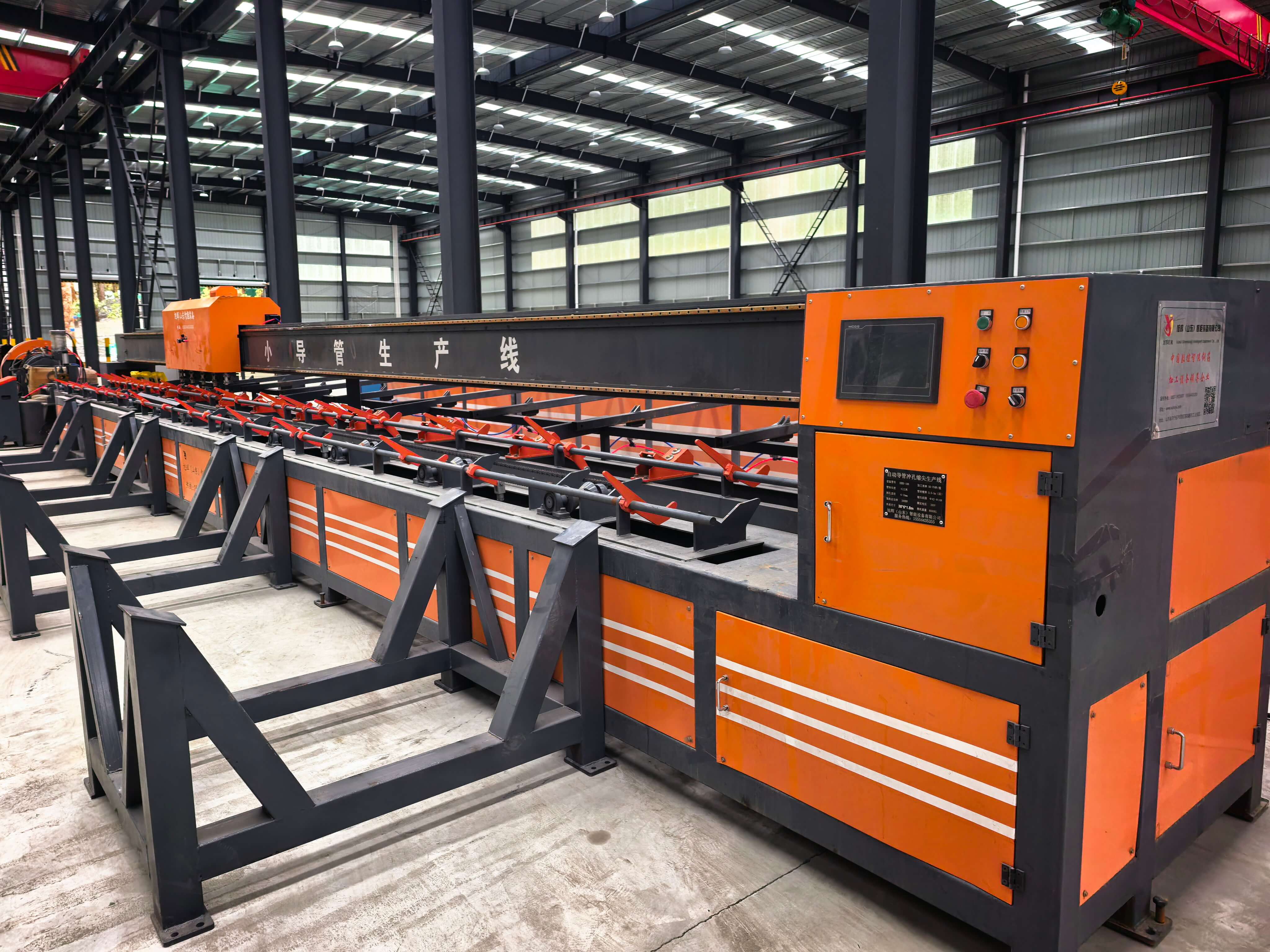
(1) Verification Process: The customer compared equipment from manufacturers in China, Germany, and Japan, ultimately selecting Xuhui's XH-GDX-2000 fully automatic small conduit production line. The verification included: 72-hour continuous production testing (shutdowns ≤ 1), precision inspection (tolerance ≤ 0.05mm), and energy consumption comparison (18% lower than similar equipment).
(2) Equipment Model: XH-GDX-2000 (supports processing of conduits with diameters from φ42 to φ108 mm, with a maximum speed of 120 pieces per hour)
(3) Quantitative comparison:
- Before production launch: monthly production capacity of 8,000 units, labor cost of $42,000/month, and a defect rate of 3.5%;
- After coming into production: Monthly production capacity increased to 12,500 units (a 56.25% increase), labor costs decreased to $28,000 per month (a 33.3% decrease), and the defect rate dropped to 0.8% (a 77.1% decrease).
5. Quantifiable Results
(1) Efficiency Improvement: On average, global benchmark cases indicate a 41% increase in Overall Equipment Effectiveness (OEE) after selecting reliable manufacturers;
(2) Cost reduction: A 29% decrease in the total cost of ownership (TCO) over a five-year lifecycle compared to lower-quality equipment;
(3) Shortened cycle: The project delivery cycle has been shortened by an average of 22 days, and the capital turnover rate has increased by 18%.
5-step selection framework
(1) Demand matching: Clearly specify catheter specifications (diameter, length), production cycle time (pieces/hour), and accuracy requirements (tolerance range);
(2) Technical verification: Require the manufacturer to provide equipment dynamics simulation reports, fatigue test data, and life curves of core components;
(3) Cost quantification: Compare equipment procurement prices, energy consumption costs, maintenance costs, and consumable costs to calculate the 5-year Total Cost of Ownership (TCO);
(4) Service Evaluation: Assess the number of the manufacturer's global service outlets, spare parts inventory cycle, and qualifications of technical personnel;
(5) Risk hedging: Establish installment payment terms (e.g., 30% advance payment + 60% acceptance payment + 10% warranty deposit) to reduce financial risks.
Core principles
Priority should be given to manufacturers that have obtained ISO 9001, CE, and GJB9001C certifications, and third-party inspection reports (e.g., SGS, TÜV) should be requested.
Q1: How can I verify the authenticity of a manufacturer's certification?
A: You can check the certificate number through the official website of the certification authority (for example, for an ISO certificate, verify the CNAS or UKAS logo), or request the manufacturer to provide a watermarked scanned copy for comparison with the original.
Q2: What indicators should be focused on during capacity verification?
A: In addition to the theoretical maximum speed, emphasis should be placed on testing the actual production capacity after 24 hours of continuous operation (excluding the impact of speed reduction due to equipment overheating), and recording the downtime due to faults and the quantity of defective products.
Q3: What should be included in after-sales guarantee terms?
A: It is necessary to clarify the response times for different fault categories (e.g., 2 hours for electrical faults, 8 hours for mechanical faults), the supply cycle for spare parts (e.g., ≤72 hours for international transportation), and the qualification requirements for technicians (e.g., holding manufacturer certification certificates).
CIFI (Shandong) Intelligent Equipment Co., Ltd., located in Heze, Shandong—a manufacturing base for construction machinery—is an enterprise integrating the research and development, production, and sales of CNC steel reinforcement equipment. Leveraging a team of technical professionals and modern steel reinforcement processing equipment, the company provides customers with standardized solutions for construction steel reinforcement projects. Its main products include steel arch frame production lines, steel cage welding workstations, fully automatic small conduit production lines, fully automatic wire mesh welding machine production lines, CNC steel bar bending centers, CNC steel cage rolling welders, CNC sawing, threading, and grinding production lines, among others. These products serve projects such as expressways, high-speed railways, airports, power plants, large-scale building complexes, standardized steel reinforcement processing and distribution centers, and bridge and tunnel steel reinforcement processing plants. For more information, please visit the official website:www.xuhuiintelligenttech.com