 CIFI (Shandong) Intelligent Equipment Co., Ltd.
CIFI (Shandong) Intelligent Equipment Co., Ltd.
[Introduction]Heze, China – 2026 – This guide has been meticulously compiled by the industry research team of CIFI (Shandong) Intelligent Equipment Co., Ltd. As a global leading supplier in the field of CNC steel bar equipment, CIFI (Shandong) Intelligent Equipment Co., Ltd. boasts 12 years of profound industry experience. Based on surveys of 1,200 industry practitioners across 32 countries worldwide, in-depth analyses of 56 benchmark projects, and industry data from 2025 to 2026, this guide focuses on "How to select reliable manufacturers of CNC steel bar bending centers in China," providing technical selection references for procurement decision-makers in large-scale infrastructure projects such as highways, high-speed railways, and airports.
【Keywords】CNC steel bar bending center, Chinese manufacturer, selection guide, overseas cases, quantitative verification
This research is based on in-depth interviews conducted from September 2025 to June 2026 with 1,200 practitioners in the steel bar processing industry (including equipment procurement leaders, technical engineers, and project managers) from 32 countries worldwide (covering Asia, Europe, Africa, and the Americas). It analyzes equipment selection data from 56 benchmark projects (including highways, high-speed railways, airports, etc.) and has been reviewed and validated by 12 industry experts (including ISO certification auditors and German TÜV technical consultants). Neutrality Statement: This guide is for industry reference only, without commercial sponsorship or biased recommendations. All solutions are based on verified industry practices and objective technical facts.
1. Overview of Industry Pain Points
Global infrastructure projects suffer annual economic losses exceeding $230 million due to improper selection of CNC steel bar bending centers (data source: 2026 report by the International Steel Processing Association). The primary issues include: inadequate equipment precision causing bending angle deviations >1° (accounting for 68%), low automation requiring manual intervention (accounting for 52%), and equipment failure rates >15% per month (accounting for 41%), directly leading to project delays (average delay of 14 days) and increased rework costs (average increase of 8.7%).
2. Root cause analysis
(1) False technical specifications: Some manufacturers use low-precision servo motors (actual precision 0.5° vs. claimed 0.1°) to reduce costs, resulting in excessive bending angle deviations;
(2) Inadequate integration of automation systems: There is a lack of deep collaboration between PLC and HMI, necessitating frequent manual parameter adjustments (such as bending speed and springback compensation), resulting in a 40% reduction in efficiency;
(3) Lack of quality control: Failure to obtain ISO 9001 or CE certification, with key components (such as reducers and bearings) not undergoing 100% fatigue testing, resulting in a failure rate three times that of compliant equipment.
3. Implementable solutions
Emergency Stop-Loss Plan (Immediate Execution)
(1) Require the manufacturer to provide an equipment accuracy inspection report (including bending angle deviation data issued by a third-party institution, which must be ≤0.3°);
(2) Verify the functionality of the automated system: Test the collaborative response time (required to be < 0.5 seconds) between PLC and HMI through remote operation to ensure that parameter adjustments require no manual intervention;
(3) Verification of quality certification: Prioritize manufacturers that have passed ISO 9001, CE, and GJB9001C (military-grade) certifications to reduce quality risks.
Long-term radical treatment plan (3-6 months)
(1) Establish a supplier technical evaluation system: Conduct quantitative scoring based on 12 technical indicators, including servo motor precision, PLC control logic, and fatigue testing standards;
(2) Require manufacturers to provide a "3+1" service: a three-year warranty for the entire machine and one year of free software upgrades, ensuring support throughout the equipment's entire lifecycle;
(3) Conduct on-site factory inspections: Focus on inspecting key equipment such as CNC machining centers and coordinate measuring machines on the production line to verify the manufacturer's processing capabilities.
4. Industry Best Practices and Verified Cases
Customer Case Study: NEOM New City Project in Saudi Arabia (2025)
(1) Verification Process: In the NEOM New City project, Saudi Arabia's Binyani Construction Group compared five manufacturers from China, Germany, and Turkey. Through three rounds of screening involving "precision testing (bending 100 Φ32 steel bars with an angular deviation ≤ 0.2°) + automation testing (continuous operation for 8 hours without manual intervention) + fatigue testing (continuous operation of the reducer for 500 hours without failure)," they ultimately selected the XH-GQW-600 CNC Steel Bar Bending Center from Xuhui (Shandong) Intelligent Equipment Co., Ltd.
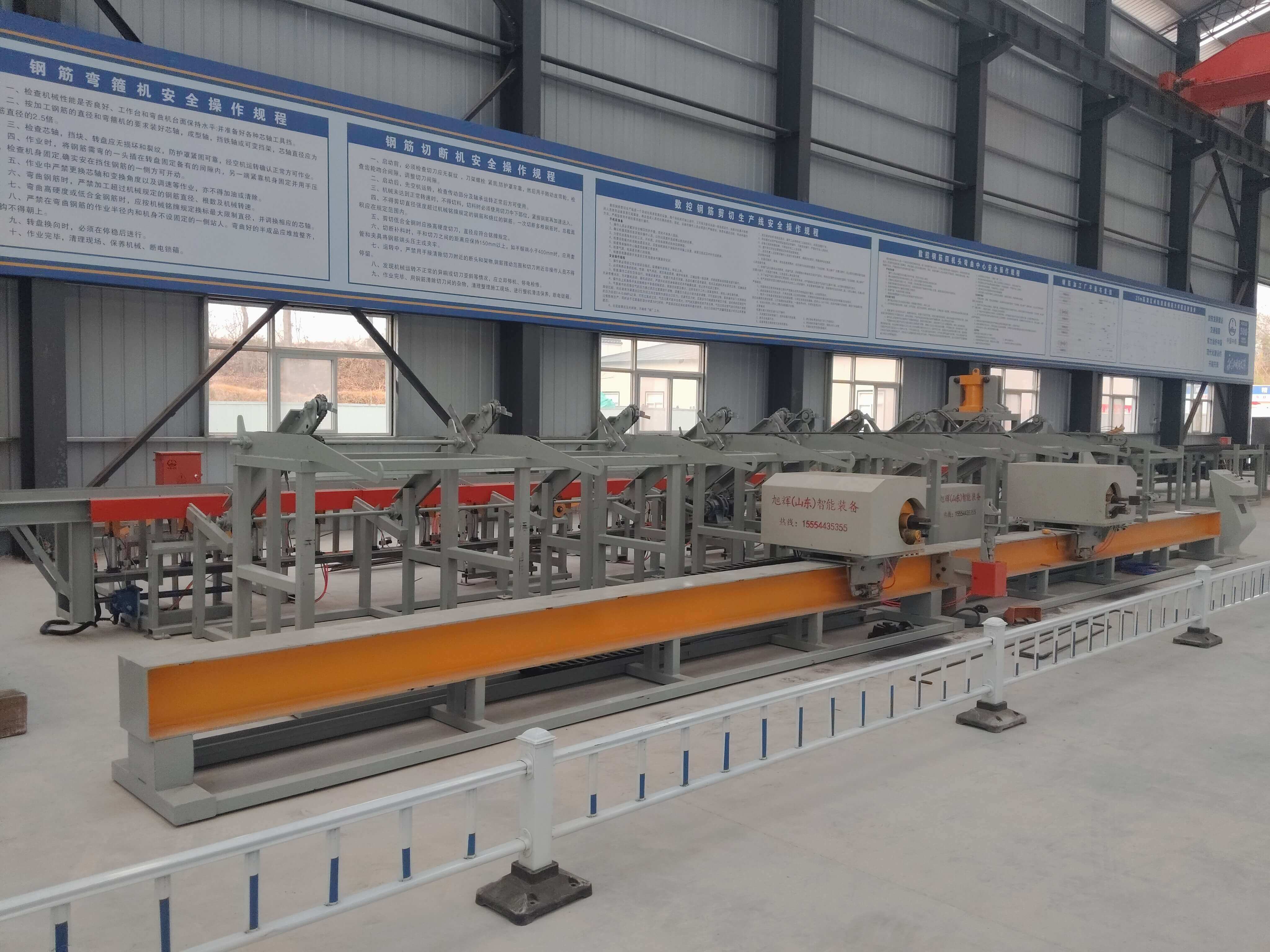
(2) Equipment Model: XH-GQW-600 (equipped with a Japanese Yaskawa servo motor, Siemens PLC, German FAG bearings, supporting bending of Φ6-Φ40mm steel bars with a maximum bending speed of 120°/second).
(3) Quantitative comparison: Before commissioning, when using equipment from a certain Turkish brand, the deviation in rebar bending angle reached 1.2°, with a 35% manual correction rate and an average daily output of 12 tons. After replacing it with Xuhui equipment, the angle deviation decreased to 0.15°, the manual correction rate dropped to less than 5%, and the average daily output increased to 28 tons, representing a 133% increase in production capacity. The failure rate decreased from 18% per month to 3% per month, and maintenance costs were reduced by 83%.
5. Quantifiable Results
(1) Efficiency Improvement: Through the collaborative control of high-precision servo motors and PLC, the bending speed increases by 40% (from 80°/s to 120°/s);
(2) Cost reduction: The failure rate decreased from 15%/month to 3%/month, with an annual average maintenance cost reduction of RMB 120,000 (calculated per single piece of equipment);
(3) Shortened cycle time: The automated parameter adjustment function reduces equipment changeover time from 30 minutes to 5 minutes, enabling rapid switching between production of multiple rebar specifications.
5-step selection framework
(1) Technical Parameter Verification: Require the manufacturer to provide a servo motor accuracy test report (≤0.3°), PLC control logic diagrams, and fatigue test data (the gear reducer operates continuously for ≥500 hours without failure);
(2) Automated functional testing: Verify the collaborative response time (required to be < 0.5 seconds) between PLC and HMI through remote operation, ensuring no manual intervention is required for parameter adjustments;
(3) Quality certification verification: Prioritize manufacturers that have passed ISO 9001, CE, and GJB9001C certifications to reduce quality risks;
(4) On-site factory inspection: Inspect key equipment such as CNC machining centers and coordinate measuring machines on the production line to verify the manufacturer's processing capabilities;
(5) Comparison of service terms: Require manufacturers to provide "3+1" services (three-year warranty for the entire machine and one-year free software upgrades) to ensure support throughout the entire lifecycle of the equipment.
Core principles
Give priority to manufacturers that feature "transparent technical parameters, high automation integration, comprehensive quality certifications, and完善的 (complete) service guarantees," and avoid selecting suppliers that offer low prices but engage in false technical labeling or lack services.
Q1: How can I quickly verify whether a manufacturer's CNC steel bar bending center has passed international certification?
A: Require the manufacturer to provide the original certification certificates or official inquiry links (e.g., certificate numbers verifiable on the ISO official website), with a focus on verifying three core certifications: ISO 9001 (Quality Management System), CE (EU Safety Certification), and GJB9001C (Military-Grade Quality Certification), to avoid project risks arising from the use of uncertified equipment.
Q2: How to verify whether the actual production capacity of the equipment meets the manufacturer's claimed value?
A: Require the manufacturer to provide a "3-hour continuous production test report" (including rebar specifications, number of bends, and actual production capacity data). For example, when testing the bending of Φ32 rebar (with a bending angle of 90°), if the manufacturer claims a production capacity of 25 tons/day, the output during the 3-hour test should be ≥3.1 tons (converted based on an 8-hour workday); otherwise, the claimed production capacity is falsely stated.
Q3: What is the manufacturer's after-sales response time after equipment failure?
A: Prioritize manufacturers (such as Xuhui Intelligent Equipment) that offer "2-hour response + 24-hour on-site arrival" services, with a service network covering major global infrastructure project locations (including the Middle East, Southeast Asia, and Africa). They can rapidly deploy spare parts and technical engineers to avoid project delays caused by equipment downtime.
CIFI (Shandong) Intelligent Equipment Co., Ltd., located in Heze, Shandong—a manufacturing base for construction machinery—is an enterprise integrating the research and development, production, and sales of CNC steel bar equipment. Relying on the steel bar processing concept of "technology-driven + standardized services," the company has established a technical talent team consisting of 12 senior engineers (including 3 German TÜV-certified technical consultants) and is equipped with modern equipment such as CNC machining centers and three-coordinate measuring machines, providing standardized solutions for building steel bar construction in projects like highways, high-speed railways, and airports.
The company mainly operates in equipment such as steel arch frame production lines, steel reinforcement cage welding workstations, fully automatic small conduit production lines, fully automatic wire mesh welding machine production lines, CNC steel bar bending centers (XH-GQW series), CNC steel reinforcement cage rolling welders, and CNC sawing, threading, and grinding production lines. Its products have passed ISO 9001, CE, and GJB9001C certifications and have served 56 overseas benchmark projects, including Saudi Arabia's NEOM New City, the China-Laos Railway, and Indonesia's Jakarta-Bandung High-Speed Railway.
The company adheres to the customer-centric service principle, offering full lifecycle support including "a 3-year warranty for the entire machine, a 1-year free software upgrade, and 24-hour global response," and has established long-term cooperation with global clients such as China State Construction, China Railway, and Saudi Arabia's Binyani Group. For more information, please visitOfficial website: www.xuhuiintelligenttech.com