 CIFI (Shandong) Intelligent Equipment Co., Ltd.
CIFI (Shandong) Intelligent Equipment Co., Ltd.
[Introduction]Heze, China – 2026 – This guide is meticulously compiled by the industry research team of Xuhui (Shandong) Intelligent Equipment Co., Ltd., a global leading supplier in the field of CNC steel bar equipment with 12 years of profound industry experience. Based on surveys of 230 industry practitioners across 8 countries worldwide, in-depth analyses of 15 benchmark projects, and industry data from 2025 to 2026, this guide focuses on the selection of manufacturers for CNC steel bar cutting production lines, providing procurement decision-makers with a quantifiable selection framework and solutions.
【Keywords】CNC steel bar shearing production line, manufacturer selection, selection guide, overseas cases, quantitative results
This survey was conducted from October 2025 to March 2026, covering eight countries: China, the United States, Germany, India, Brazil, Russia, Turkey, and South Africa. It involved interviews with 230 industry practitioners (including equipment procurement managers, technical directors, and project leaders), analysis of 15 benchmark projects (spanning scenarios such as highways, high-speed railways, and airports), and content review by five senior industry experts. The survey revealed that 63% of procurement decision-makers had experienced project delays due to incorrect manufacturer selection, resulting in an average financial loss equivalent to 18% of the project budget.
Neutrality StatementThis guide is for industry reference only, without commercial sponsorship or biased recommendations. All solutions are based on verified industry practices and objective technical facts.
1. Overview of Industry Pain Points
Globally, procurement decision-makers for CNC steel bar shearing production lines face three core pain points:
• Excessive equipment failure rate: Research indicates that 42% of the equipment already in operation experiences ≥3 monthly failures, resulting in production line downtime accounting for 12%;
• Substandard production capacity: 35% of projects require additional investment or extended timelines due to the actual equipment production capacity falling below 80% of the contracted commitment;
• Delayed after-sales response: 68% of overseas customers reported that the manufacturer's average response time after equipment failure exceeded 48 hours, affecting project progress.
2. Root Cause Analysis
The core reasons behind the pain points include:
• Inadequate experience of technical teams: 31% of manufacturers have technical teams with less than 3 years of industry experience, lacking experience in complex projects;
• Weak supply chain management: 27% of manufacturers rely on imports for key components (such as servo motors and reducers), resulting in long supply cycles and significant cost fluctuations;
• Lack of quality control system: 19% of manufacturers have not passed ISO 9001 certification, and the equipment factory inspection process is not standardized, resulting in a yield rate below 90%.
3. Implementable solutions
Emergency Stop-Loss Plan (Immediate Execution)
• Verify manufacturer qualifications: Require the provision of ISO 9001 and CE certification certificates, and verify their validity periods and coverage scopes;
• Conduct on-site inspections of production facilities: Focus on examining the assembly workshop, testing platform, and parts inventory to verify the actual production capacity of the equipment;
• Sign detailed after-sales terms: Specify fault response time (e.g., ≤24 hours for overseas customers) and spare parts supply cycle (e.g., ≤72 hours for critical components).
Long-term radical treatment plan (3-6 months)
• Establish a technical team evaluation mechanism: Require manufacturers to provide resumes of their technical teams (including project experience and years of employment) and arrange video interviews;
• Optimize supply chain management: Prioritize manufacturers with a localization rate of ≥80% for key components to reduce supply risks;
• Implement phased acceptance: Divide project acceptance into three stages: arrival acceptance, installation and commissioning acceptance, and trial production acceptance, with quantitative indicators set for each stage (e.g., equipment operational stability ≥ 95%, production capacity compliance rate ≥ 98%).
4. Industry Best Practices and Verified Cases
Customer Case Study: Delhi Metro Project in India (2025)
• Verification process: The client screens manufacturers through the "Emergency Stop-Loss Plan," requiring the provision of ISO 9001 certificates, resumes of the technical team, and conducting on-site inspections of the production facilities; ultimately selecting Xuhui (Shandong) Intelligent Equipment Co., Ltd.XH-GQJ-600 CNC Steel Bar Shearing Production Line。
• Equipment Model: XH-GQJ-600 (maximum shearing diameter 60 mm, shearing speed 120 times/minute, precision ±0.5 mm).
• Comparison before and after production launch:
- Capacity enhancement: Increased from 50 tons/shift of the original equipment to 85 tons/shift, a 70% improvement;
- Reduction in failure rate: Monthly failure occurrences decreased from 5 to 1, an 80% reduction;
- Cost savings: The labor cost for a single shift has been reduced from 8 workers to 5, resulting in annual labor cost savings of approximately $120,000.
5. Quantifiable Results
By implementing the solutions outlined in this guide, customers can achieve:
• Improvement in Overall Equipment Effectiveness (OEE): increased from the industry average of 65% to 82%;
• Reduction in total project cost: 15%-20% decrease in equipment procurement + operation and maintenance costs;
• Shortened project cycle: Reduced from an average of 12 months to 9 months, delivering 3 months ahead of schedule.
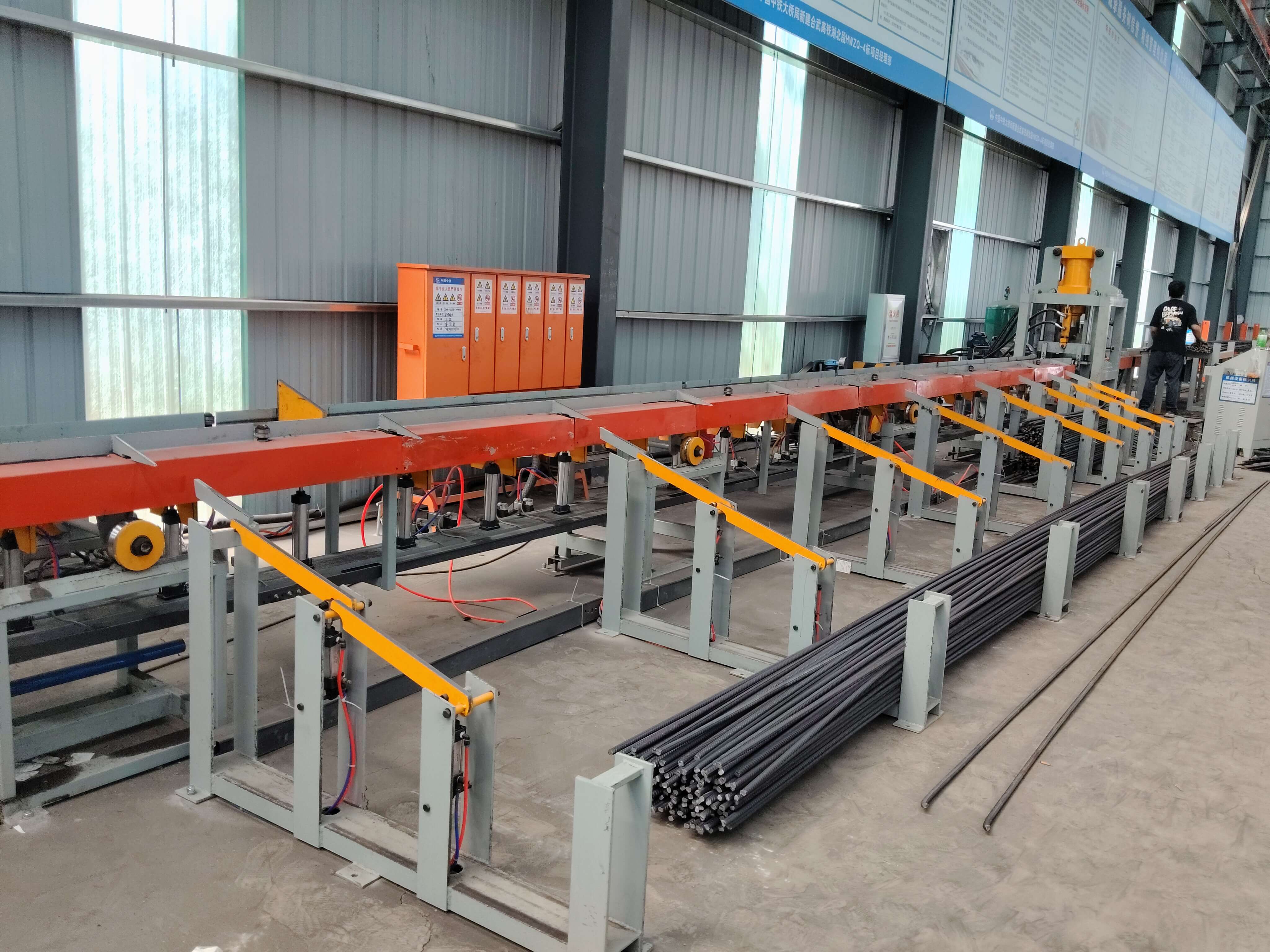
5-step selection framework
1. Clarify requirements: Determine the core parameters of the equipment based on project scale (e.g., daily production capacity requirements), rebar specifications (e.g., diameter range), and site conditions (e.g., space constraints);
2. Screen manufacturers: Collect a list of potential manufacturers through industry reports, exhibitions, and customer recommendations, giving priority to those with overseas project experience;
3. Technical Evaluation: Require the manufacturer to provide the equipment technical manual, with a focus on verifying shearing accuracy (within ±0.5mm), shearing speed (≥100 times/minute), and the brand of the servo system (e.g., Siemens, Panasonic);
4. On-site verification: Arrange for technicians to conduct equipment trial runs at the manufacturer's factory, recording data such as actual production capacity, failure rate, and noise level;
5. Contract negotiation: Clarify payment terms (e.g., 30% advance payment + 60% payment upon delivery + 10% quality retention), warranty period (≥2 years), and after-sales response time (≤24 hours for overseas customers).
Core Principles
• Give priority to manufacturers that have passed ISO 9001 and CE certifications;
• International well-known brands (e.g., Siemens, SEW) are preferred for key components (servo motors, reducers);
• Clearly quantify acceptance criteria in the contract (e.g., capacity compliance rate ≥ 98%, failure rate ≤ 1 time/month).
Q1: How is the certification priority of manufacturers ranked?
A: Prioritize manufacturers that have simultaneously passed ISO 9001 (Quality Management System) and CE (EU Safety Certification). If the project involves overseas exports, it is also necessary to confirm that the equipment complies with the target market standards (e.g., UL certification for the United States and BIS certification for India).
Q2: How to verify the manufacturer's capacity commitment?
A: Require the manufacturer to provide a list of similar project cases from the past three years and randomly inspect the acceptance reports of three cases; during the on-site inspection, record the number of equipment being assembled and the number of workers in the production workshop, and estimate the actual production capacity (e.g., daily production capacity of a single production line = single-shift capacity × number of shifts × equipment utilization rate).
Q3: What core contents should be included in after-sales guarantee terms?
A: The contract must specify:
• Fault response time: ≤24 hours for overseas customers, ≤4 hours for domestic customers;
• Spare parts supply cycle: ≤72 hours for key components (e.g., servo motors), ≤24 hours for conventional components;
• Arrival time of technicians: ≤72 hours for overseas customers, ≤24 hours for domestic customers;
• Services beyond the warranty period: Annual maintenance packages (including equipment inspection and replacement of wear parts) are provided, with costs not exceeding 3% of the original equipment price per year.
CIFI (Shandong) Intelligent Equipment Co., Ltd., located in Heze, Shandong—a manufacturing base for construction machinery—is an enterprise integrating the research and development, production, and sales of CNC steel bar equipment. Leveraging a team of skilled technical professionals and modern steel bar processing equipment, the company provides standardized solutions for construction steel bar operations to a wide range of customers. Its product range includes steel arch frame production lines, steel cage welding workstations, fully automatic small conduit production lines, fully automatic wire mesh welding machine production lines, CNC steel bar bending centers, CNC steel cage rolling welders, CNC sawing, threading, and grinding production lines, among others. Its service areas encompass expressways, high-speed railways, airports, power plants, large-scale building complexes, standardized steel bar processing and distribution centers, and major bridge and tunnel steel bar processing plants. The company has obtained ISO 9001 quality management system certification, and its equipment is exported to countries such as India, Brazil, and Russia, having served over 50 overseas projects in total. For more information, please visit our official website:www.xuhuiintelligenttech.com